
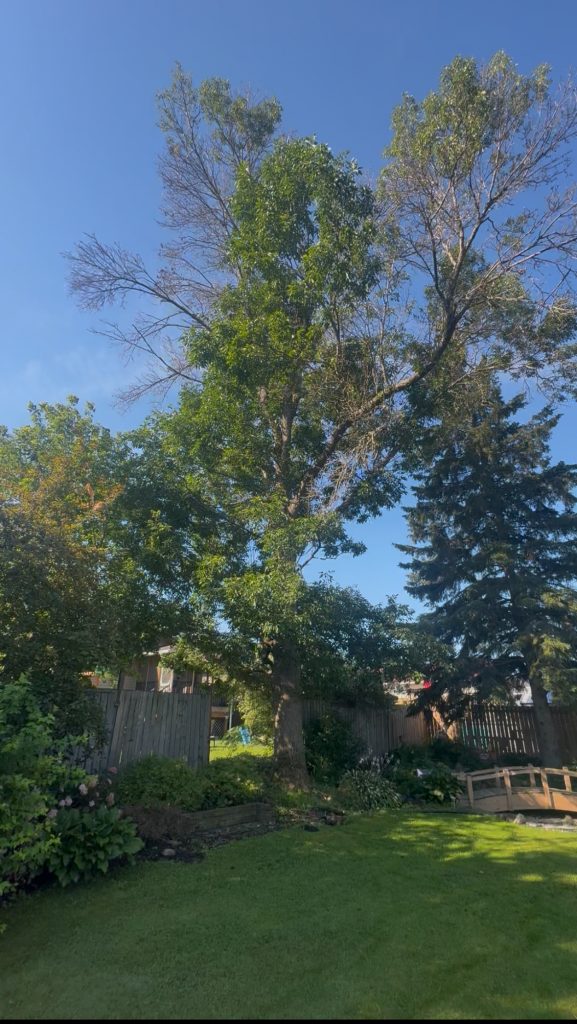
As of 12–14 September 2026, Ontario Parks was reporting leaf fall at zero and colour change at 0–10 per cent in the parks closest to Ottawa — Bon Echo, Charleston Lake, Frontenac, Sharbot Lake and Murphys Point. The bush around this city has barely started. So if one tree in your yard is already yellow, thin, or dropping leaves, that is not autumn arriving early. That is one tree doing something the trees around it are not.
We get this question more than any other in September. Here is what is worth checking, in the order we check it.
The rest of the street is your control group
Fall colour runs roughly on schedule within a species. Same kind of tree, same street, same light — they turn together, give or take a few days. That makes your own block the most useful measuring stick you have. For a wider baseline, Ontario Parks publishes colour-change and leaf-fall numbers through the season, and the eastern Ontario parks are the closest read to this area.
- The whole street is turning together. That is the season, or a leaf problem that hit the whole neighbourhood. Not a structural worry.
- Only that species is turning. Usually a disease or insect specific to it. Rarely urgent.
- One tree is turning and its neighbours are not. That is the one to look at, and the cause is almost always below the leaves.
Early colour is a stress signal, not a weather report
A tree drops leaves early because it cannot keep supplying them. Water is not reaching the crown in the volume it needs, so the tree shuts the leaves down and pulls what it can back out of them. Same process as normal autumn, triggered by a problem instead of shortening days.
John Bonkowski of the Purdue Landscape Report, in a piece dated 20 September 2023: “Plants will often show yellow or red foliage coloration during periods of stress, so this may occur at any point during spring, summer, or fall.” His checklist is the root flare, trunk and root damage, girdling roots, grass competition at the base, and compaction. Notice what is not on it: anything you can spray.
One local correction first. Most writing about early fall colour blames drought, and in Ottawa this year that is backwards. CTV News Ottawa reported on 12 August 2026 that this was the wettest summer in the city’s history. Advice about deep-watering a thirsty tree was written for somewhere else.
Start at the bottom of the trunk, not the top
Look at where the trunk meets the ground before anything else. A healthy tree widens at the base like a foot in a boot — it flares. If the trunk goes straight into the soil like a post, something is buried or wrapped around it.
What we find most often is a girdling root: a root that circled the trunk instead of growing away, squeezing harder as both thicken. It strangles the tree from the outside in, with nothing visible above shoulder height until the leaves go early.
University of Maryland Extension, last updated 19 April 2024, lists the leaf symptoms as “lighter green, scorched, and show early fall color and leaf drop” and gives the field test: if “one side of the trunk is straight, with no natural flare, digging may indicate a girdling root below the soil surface.”
Ten minutes with a trowel:
- Pull the mulch and soil back until bark meets dirt, 10 to 15 cm out all the way round.
- Look for a root crossing the trunk or pressed hard against it.
- Feel for the flare on all four sides. One flat side where the others flare is the tell.
- Leave it open. Bark was never meant to be underground.
Pot-grown stock arrives with roots already circling, planting an inch too deep puts roots at the wrong level, and mulch heaped against a trunk invites roots up into it. All three happen at planting. The bill arrives fifteen years later.
The tree in the strip between the driveway and the house
The other common cause is not a defect — the tree is in the wrong place. A tree with a metre of open soil between a driveway slab and a foundation has a crown sized for a yard and roots sized for a flower bed. It copes while it is small. Then the crown outgrows what the roots can supply and the tree starts editing itself: early colour, thin upper branches, dead tips.
On Ottawa clay it arrives sooner, because roots in heavy soil do not travel as far. The pattern is a tree that has looked slightly worse every September for three or four years, not one that changed suddenly.
Straight about it: there is no fix that involves the tree. You cannot give it more soil. You can stop making it worse — grass off the root zone and a flat mulch bed instead, salt and snow piles kept off, nobody parking or changing the grade there. That buys years. It does not buy a different tree.
Old damage to the trunk shows up in the leaves
A tree moves water and sugar through a thin layer just under the bark, not through the middle. That is why a tree can be hollow and still fine, while one with a strip of dead bark is in real trouble.
What we find at the base of early-colouring trees, in rough order:
- Mower and string-trimmer scarring built up over years into a band of dead bark.
- Nursery staking left on — a wire or strap that should have come off after one season and has cut in.
- A cut made flush to the trunk, which removes the collar of tissue that would have closed the wound.
Trees do not heal wounds. They grow over them and wall them off, and the wood behind stays damaged. So the question is not whether it looks bad but how much of the trunk’s circumference is dead. And this detail is worth a photo: if the early colour is on one side of the crown and the trunk damage is on that same side, you have found your answer.
When it is none of this
Plenty of early leaf drop here is not about roots or trunks at all:
- Spots on the fallen leaves. A leaf disease that hit the whole neighbourhood after a wet summer, and less serious than it looks — see black spots on maple leaves.
- Mushrooms or a hard shelf at the base. Different problem, different urgency — see which mushrooms actually matter.
- Digging or paving near the tree in the last five years. Root loss shows up late and looks exactly like this — see cutting tree roots.
- It is an ash. Start with emerald ash borer before anything on this page.
What we would not do
We would not take a tree down in September because it coloured early. Early colour is a symptom with a dozen causes and several are fixable. A tree that goes early one autumn and leafs out properly next May was telling you about the season it just had. Watch it through a spring first.
We would not cut a root thicker than your wrist on the strength of a web page. Maryland Extension draws the line at about two inches — roughly 5 cm — and says get someone to look at anything bigger. Severing a structural root to relieve a girdling one can trade a slow problem for a tree that comes over in a windstorm.
We would not pile more mulch on it. Mulch against the trunk is part of how this starts. Flat bed, pulled back off the bark.
We would not water it on a schedule this year. Saturated ground drives out the air roots need, and that produces the same thin, early-colouring crown people try to cure with more water.
If you want eyes on it
Quotes are free and photos are fine to start with: the whole tree from far enough back to see the top, the base of the trunk with the mulch pulled away, and some of the fallen leaves.
If the tree stands over a house, a driveway you park in, or somewhere people sit, call instead of emailing — (613) 715-0103. Nobody can call a tree safe from a photograph. Max does every assessment himself and is Tree Risk Assessment Qualified (TRAQ). Our minimum charge is $160 + HST, and it covers everything.
More: get in touch · tree removal
Quick answers
My tree turned colour in September. Is that normal in Ottawa?
Not usually, and comparison is the easiest way to judge. Ontario Parks had the parks nearest Ottawa at 0–10 per cent colour change and zero leaf fall on 12–14 September 2026. If the same species on your street are still green, your tree is early — and early means stressed rather than seasonal.
What is a girdling root, and can it be cut off?
It is a root that grew in a circle around the trunk instead of away from it, strangling the trunk as both thicken. Small ones can be cut out. University of Maryland Extension puts the threshold at roughly two inches across, about 5 cm, above which you want someone looking at it in person — on an older tree that root may also be holding the tree up.
Only one tree in my yard is dropping leaves. Does that rule out disease?
It makes a neighbourhood-wide leaf disease unlikely but does not rule out something specific to that tree. The split that matters is whether the leaves themselves look diseased. Spotted, blotched or mouldy leaves point at a leaf problem; small, pale leaves falling clean point at the roots or trunk.
How long does a stressed tree have?
There is no honest number, and anyone giving you one over the phone is guessing. It depends on the cause and whether it can be removed. A girdling root caught early can be dealt with. A tree that has outgrown a metre of soil is on a slow decline nothing reverses. What matters more than a prediction is whether next spring’s leaves come out full.
Photo: Max Trees, Ottawa — a mature backyard tree with heavy dieback through the upper crown, photographed before removal. Sources, verified 16 September 2026: Ontario Parks fall colour report (park reports dated 9–14 September 2026); CTV News Ottawa, 12 August 2026, wettest summer on record; Purdue Landscape Report, John Bonkowski, 20 September 2023; University of Maryland Extension, girdling roots, updated 19 April 2024. This guide describes patterns, not your tree, and is not an assessment of any specific tree’s safety.
Terms used on this page (root flare and girdling root) are defined in plain language in the Ottawa tree service glossary.
Related: the Ottawa tree care calendar for what to do in each month (dead wood and hangers come out now; structural pruning waits for February-March) · leaning tree in Ottawa if the base shows heaved soil · our published prices if it does come to a removal.
Before the snow, look at the bottom of your own trunks: mower and string-trimmer damage at the root flare is the wound that shows up in the crown three or four years later. On a young maple or birch the bark is about 1.5 mm thick, a trimmer takes it off in one pass, the damage is irreversible, and a wound all the way round the base is fatal. The fix is a mulch ring: at least three feet of ring for every inch of trunk caliper on a young tree, with 4 to 6 inches of bare ground between the bark and the mulch.
Max Trees publishes its prices: see the full 2026 price schedule for Ottawa tree removal, pruning and stump grinding.
Worried the wet summer hurt your trees? Read which Ottawa trees mind waterlogged soil and which do not: standing water for a week or less is harmless, the weeks of airless clay afterwards are not; spruce, sugar maple and oak are the ones to watch, silver maple and honeylocust will not have noticed, and the damage usually shows next May, not this fall.
Planted a tree this year, or took one of the City’s free ones? Read what actually kills a newly planted tree in an Ottawa winter: it is the strap left around the trunk, mulch piled against the bark and rabbits in March, not the cold — and after this wet summer, check the soil before you water.