
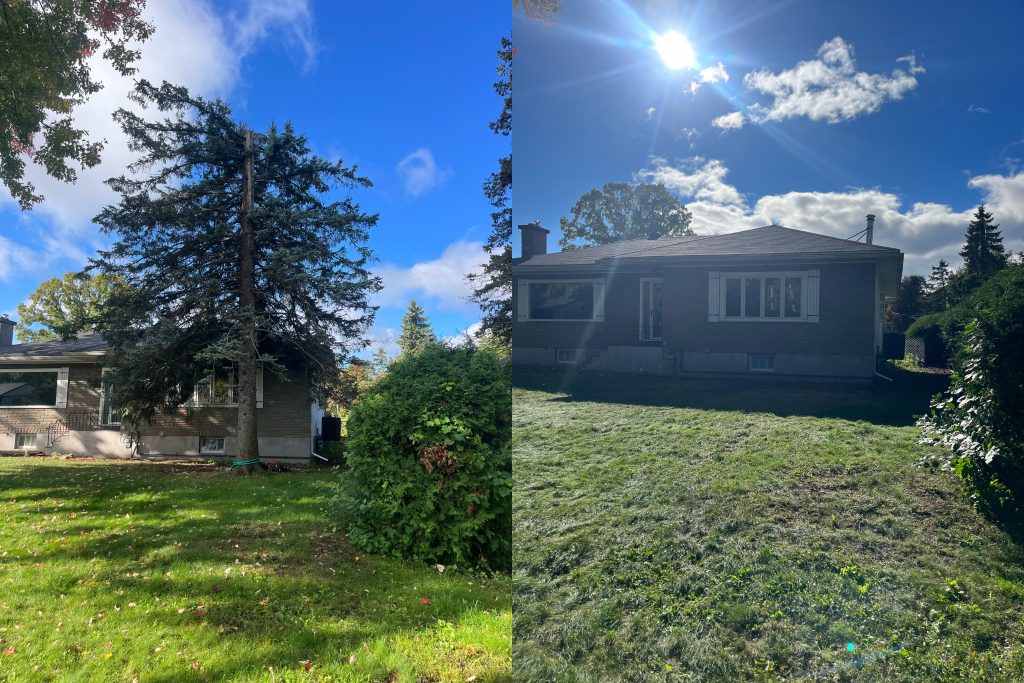
Wet ground does not hold a tree the way dry ground does. In a 2022 study that measured the force needed to pull trees out of the ground, the soil’s holding power dropped by 35 to 50 per cent once it was near saturation compared with the same soil when it was dry. The tree does not change. What it is anchored in does.
Ottawa has just come through the wettest summer in its recorded history, and the ground has not caught up. So if a tree leans toward your house or driveway, the question to settle before the fall wind season is not “how far over is it.” It is “is the ground at the base moving.” You can answer most of that yourself in five minutes.
The lean itself is usually not the problem
Trees lean for dull reasons: light around a garage, forty years of prevailing wind on a woodlot edge. A tree that has leaned the same amount for two decades has been building wood on the compression side the whole time, and it is generally better anchored for that lean than a straight tree would be.
The lean that matters is the new one. As the Virginia Tech Tree Steward Manual puts it, an established lean with corrective growth suggests the tree has adapted — but “if the lean is recent or getting worse it is a matter of concern.”
So find out whether it moved. Pick a fixed reference — a fence post, a gutter line, the corner of the shed — and stand in the same spot each time. A photo of the yard from last summer beats squinting.
What to look at, and it is not the trunk
Everything useful is in the first two metres of ground around the base. Walk a full circle and look for:
- Soil heaving on the side away from the lean. This is the one. The Tree Steward Manual is blunt: raised roots or soil away from the lean, “and/or there is a corresponding indentation on the side it is leaning toward,” indicates the roots are pulling out.
- A crescent-shaped crack in the turf, often a thin arc a metre or two out on the side opposite the lean. In lawn it can read as a mower scar. It is not.
- Roots visible now that were not before, particularly large ones angling up out of the ground.
- A gap between trunk and soil. Push a stick in beside the flare. If it goes in easily on one side and not the other, something has shifted.
- Ground that stays spongy days after rain. Not a failure sign on its own, but it is the condition that makes every other sign worse.
Photograph anything you find with a shoe in the frame for scale, and look again after the next windy day.
Why Ottawa ground makes this worse than it needs to be
Two things stack here. The first is what we are built on: much of Ottawa sits over Champlain Sea deposits, the heavy grey clay everyone digs into eventually and commonly called Leda clay. It holds water and gives it up slowly. A week of rain in sand is gone by the weekend; on clay it is still in the root zone a fortnight later.
The second is where roots actually are, which is not where most people picture them. There is no deep taproot holding your maple down. Roughly 90 to 95 per cent of a tree’s roots sit in the top metre of soil, more than half of those in the top 30 centimetres, spreading outward two to four times the width of the crown. That is not a post sunk in the ground. It is a wide, shallow plate — and this year the plate has spent three months in saturated clay.
The wet is not hypothetical. The Rideau Valley Conservation Authority issued a Water Safety Statement on 10 August 2026 over elevated flows and levels, and it is still listed on their current conditions page as of this writing.
The trees that go over, and the ones that break instead
- Conifers tip whole. Spruce, pine and cedar hold full foliage through fall and winter, so they keep their sail after the hardwoods drop theirs. A big spruce close to a house is the classic Ottawa root-plate failure.
- Dead ash breaks rather than leans. Emerald ash borer kills the tree standing, and standing dead ash sheds limbs and snaps at the trunk long before the roots let go — a different problem with a different inspection. How to tell if your ash is done →
- Trees that lost roots to a project. A driveway widened, a fence line trenched, a service line run. Once more than about a third of the main structural roots are gone the tree is in a different risk category, and it will not look any different from the street for years. Same for a tree newly exposed when the neighbour takes down the row that used to shelter it.
What we would not do
We would not winch a mature tree upright and stake it. On a sapling, staking is fine and temporary. On a trunk you cannot get your arms around, the root plate has already torn on one side and pulling the top back over re-attaches nothing. It buys a year of false confidence and a set of cables that will girdle the trunk once everyone forgets them.
We would not cable it to the house, the garage or another tree. A root failure delivers the whole mass of the tree at once, and you have just attached that to a wall.
We would not top it. Cutting a crown back to stubs is not a crown reduction. Topping triggers a flush of weakly attached regrowth, and in three years the tree carries the same sail on worse attachments. A competent reduction or thinning lowers wind load; hacking the top off does not.
We would not shovel soil over heaved roots to level the lawn. That buries the only evidence you have, and burying a root flare is its own slow problem.
And we would not remove a healthy sixty-year-old maple because it leans and always has. The reflex after a bad storm season is to take everything down. Most leaning trees in this city are fine, and a tree you cannot replace inside twenty years deserves a decision rather than a reflex.
If the ground is flat and the lean is old, you have time
That is the common case, worth saying plainly so nobody loses a weekend to it. No heaving, no crack, no hollow, a lean that matches an old photo — that tree is doing what it has always done. What is worth doing before winter:
- Reduce the sail, not the tree. A thinning or modest reduction on a big conifer or a dense Norway maple takes real load off the roots for wet snow and fall wind, at a fraction of an emergency callout.
- Move the target if you can. You cannot move the house, but you can stop parking under the spruce in Kanata for the windy stretch.
- Leave the root zone alone. No trenching, no regrading, no compacting, no soil piled against the flare. Mulch out to the dripline is fine; soil is not.
- Look again after each real blow — two minutes, same spot, same angle.
If you want eyes on it
We give free quotes and we will look at photos — a wide shot of the whole tree plus two or three close shots of the ground at the base usually tells us whether it needs a visit. For anything you think is moving, call (613) 715-0103 rather than the form. The phone is faster.
Two other numbers. If the tree stands on City land — road allowance, park, municipal woodlot — it is Forestry Services’ tree, not yours, and the route is 3-1-1. If any part of a tree is touching a hydro wire, that is a 9-1-1 call before it is a tree-service call; the sequence is in our guide to storm-damaged trees →
On permits: the Tree Protection By-law exempts genuine emergency hazard removals, but a tree that merely leans is not automatically one. Photograph the condition either way. Permit thresholds and exemptions → · Get a free quote →
Quick answers
My tree has leaned for years. Is it dangerous?
Usually not. A long-standing lean gives the tree time to build reaction wood on the compression side, so it is generally well anchored for that position. The concern is a lean that is new or getting worse. Compare it against a fixed reference like a fence post, or an old photo of the yard.
How can I tell if a tree’s roots are failing?
Look at the ground, not the trunk. The clearest sign is soil heaving or a crescent-shaped crack in the turf on the side away from the lean, often with a matching dip on the side it leans toward. Newly visible roots, or a gap where the trunk meets the soil, point the same way. Any of those near a house is worth a phone call.
Can a leaning tree be straightened or cabled?
A young tree can be staked temporarily while it establishes. A mature tree cannot be meaningfully straightened: if the root plate has torn, pulling the top back over does not repair it, and cabling a tree to a building attaches the failure to your house. Reducing the crown to lower wind load is the useful intervention; straightening is not.
Does a leaning tree need a permit to remove in Ottawa?
It depends on the trunk diameter, the property, and whether the tree is a genuine imminent hazard, since the Tree Protection By-law exempts emergency hazard removals. A tree that leans but shows no sign of root movement generally does not qualify. Photograph the condition before any work either way, and check the thresholds before booking.
Photo: Max Trees, Ottawa. Sources: Fan, Li & Lu, Forests 13(11):1875, 2022 (soil moisture and anchorage); Virginia Tech Tree Steward Manual, ch. 11 (root distribution, root-plate heaving); CTV News Ottawa, 12 Aug 2026; Rideau Valley Conservation Authority (Water Safety Statement, 10 Aug 2026); Library and Archives Canada (Champlain Sea clay).
Need it dealt with now? See emergency tree removal in Ottawa: what counts as urgent, what a storm callout costs (1.5x the published schedule), and the by-law hazard exemption.
Max Trees publishes its prices: see the full 2026 price schedule for Ottawa tree removal, pruning and stump grinding.