
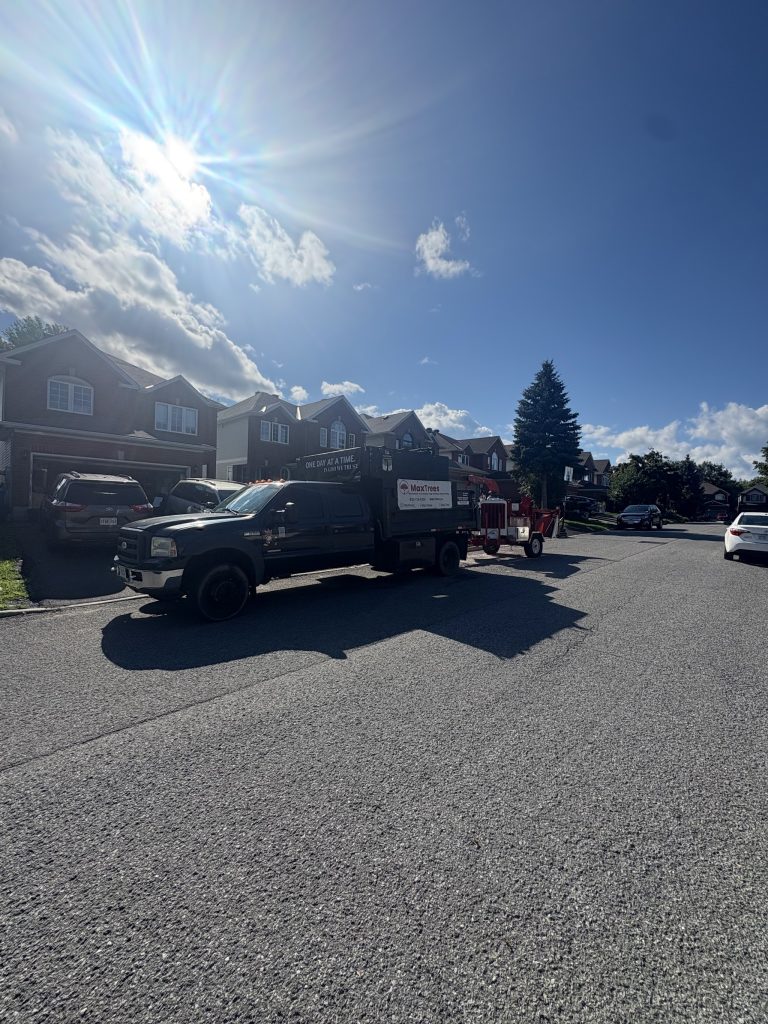
Nobody in Ontario needs a licence to run a tree company. Arborist is a real trade here — 6,120 hours of it, 5,400 on the job and 720 in school, per Skilled Trades Ontario — but it is a non-compulsory trade. That means a person can buy a saw on Saturday, put magnets on a pickup Sunday, and legally knock on your door Monday morning offering to take down the maple that split in the storm. The training is optional. The chainsaw is not.
So “are you licensed?” is the wrong question in this province. The right one is what you can actually verify before you sign, and two documents do most of the work. Here is how we would go about hiring a tree service in Ottawa if it were our own house, and what we would refuse to do.
Ottawa is in door-knocker season right now
The storm on the night of 12 August 2026 gusted to 107 km/h at the airport, dropped 21.9 mm of rain, and put more than 10,000 Hydro Ottawa customers in the dark by 5 a.m. By 2 p.m. the next day the City had taken 375 storm service requests, and one ward councillor alone reported around 50 hazardous tree calls (CP24, 13 August 2026).
Every one of those events produces the same pattern a week later: unfamiliar trucks working a street, a knock at the door, and a price that sounds too good with a signature wanted today. Some of those crews are fine. Some are three guys and a rented lift who will be in another city by Friday. You cannot tell them apart by the truck. You can tell them apart by the paperwork.
Paper one: a WSIB clearance — and pull it yourself
A WSIB clearance is a number issued to a registered business showing it is registered and up to date on its premiums and reporting. It is valid for up to 90 days, and anyone can request one online without an account.
That last part is the whole point. Do not accept a screenshot or a photo of a card. Ask for two things — the company’s exact legal name and its WSIB account or clearance number — and pull the clearance yourself on the WSIB site. It is free and takes about two minutes.
- If the clearance comes back valid, the business exists on paper and is current with WSIB. That is the floor, not the ceiling, but it rules out a lot.
- If they cannot give you a legal name, stop there. A company that will not tell you what it is called on its own tax filings is telling you something.
- If they say they do not need WSIB, that can be true — some independent operators outside construction are not obliged to register. Understand what it means, though: no workplace insurance stands behind the person forty feet up in your tree. Call your own insurer and ask what your policy does if someone is hurt on your property. Ask before the saw starts.
Paper two: a certificate of insurance that came from the broker
The second document is a certificate of insurance for commercial general liability. The version that matters comes from the broker or insurer directly to your inbox. The laminated card in the glovebox is not it. When it arrives, read four lines:
- The named insured — it has to be the same business name that is on your quote. Not the owner’s personal name, not a similar name, not a numbered company you have never heard of.
- The policy dates — the coverage has to be in force on the day the work happens, not the day the quote was written.
- The limit — two million is the common commercial general liability limit in this trade. A removal beside a house can outrun a small one in a hurry.
- The exclusions — where cheap policies hide. Ask in writing whether removal, climbing, and aerial lift work are covered. Some policies cover landscaping and quietly exclude the part where a person is in the canopy with a saw.
Any legitimate outfit has been asked this before and can have it to you the same day. Irritation at the question is information.
Credentials worth asking about — and one you can verify in a minute
- ISA Certified Arborist is the common one, and the International Society of Arboriculture runs a public credential lookup. Ask for the name on the certificate and check it. Names get borrowed.
- Who is actually climbing matters more than who owns the company. Ask who will be in the tree on your job and what training they have — chainsaw, rigging, aerial rescue, first aid.
- Aerial rescue is the question that separates crews. Ask when they last practised getting an injured climber out of a tree. A working crew has an answer.
You have ten days to cancel anything you signed at your door
A contract negotiated in person somewhere other than a place of business is a direct agreement under Ontario’s Consumer Protection Act. For those, the province’s own guidance is clear: anything over $50 needs a written copy, you can cancel for any reason within 10 days of receiving that written copy, and the business has 15 days to return your money.
Which means the pressure tactic — sign now, today only, we can start in an hour — is aimed squarely at the one protection you have. If someone at your door will not leave a written copy of what you just agreed to, they have handed you your reason to walk.
What we would not do
- We would not pay in full up front. A deposit on a multi-day job or a crane booking is normal and belongs in the written contract. Full payment in cash before a single cut is not a deposit, it is a risk transfer, and it goes one direction.
- We would not sign on a same-day discount. “We’re already on your street, half price if you decide now” is a sales script, not a route efficiency. A real crew can hold a price for a week.
- We would not accept a verbal quote for a removal near a structure. Get it in writing: the tree identified, whether the stump is included, where the wood and chips go, and what cleanup actually means.
- We would not let anyone wear spikes to prune a tree they are keeping. Spikes are for removals. On a tree that is staying, every spike hole is a wound.
- We would not skip the permit question on a large tree. Ottawa’s tree by-law does not care who cut it — the property owner wears the fine. If the tree is big or near the road, read our Ottawa tree removal permit guide before anyone starts.
- We would not hire a crew quoting less than half of everyone else. That gap is not efficiency. It is usually the insurance, the WSIB, or the cleanup, and you find out which one afterwards.
The five-minute phone screen
You can sort most of this out before anyone visits:
- What is your full legal business name and WSIB account number? Then pull the clearance yourself.
- Can your broker email me a certificate of insurance? Direct from the broker, showing dates, limit, and that climbing and removal are covered.
- Who is climbing, and what is their training? A name and a list, not “all our guys are certified.”
- What is written into the price? Stump, wood, chips, brush, ruts, the lawn.
- How long is this quote good for? If the answer is “today,” you have your answer.
Do that with three companies and the field sorts itself out fast. It is also what we expect to be asked, and we would rather quote against someone who asked than someone who did not.
If you want eyes on it
Quotes are free and we do not charge to look. Photos are usually enough for a ballpark — one of the whole tree from far enough back to see the top, plus one of the base — and we will tell you honestly whether it needs to come down or whether it needs nothing at all.
If a tree is on a house, on wires, or hanging over somewhere people walk, do not wait for an email. Call (613) 715-0103.
Get a quote · Tree removal · Pruning · What to do with a storm-damaged tree
Quick answers
Do tree companies need a licence in Ontario?
No. Arborist is a non-compulsory trade in Ontario, so there is no provincial licence required to sell or perform tree work. Certification through the apprenticeship system or the International Society of Arboriculture is voluntary. That is why checking WSIB and liability insurance matters more here than asking whether a company is “licensed.”
How do I check a WSIB clearance certificate myself?
Ask the company for its exact legal business name and WSIB account or clearance number, then request the clearance yourself through the WSIB website. It is free, does not require an account, and takes a couple of minutes. A clearance is valid for up to 90 days, so check the date on the one you pull.
Can I cancel a tree work contract I signed at my door?
In most cases, yes. A contract negotiated in person away from the company’s place of business is a direct agreement under Ontario’s Consumer Protection Act, and you can cancel it for any reason within 10 days of receiving a written copy. Anything over $50 requires that written copy, and the business has 15 days to refund you.
How much liability insurance should an Ottawa tree service carry?
Two million dollars in commercial general liability is the common limit in this trade, and it is what we would want to see on any removal near a house, a fence, or wires. Just as important as the number is whether climbing, removal, and aerial lift work are actually covered rather than excluded — ask the broker to confirm that in writing.
Photo: Max Trees. Sources: Skilled Trades Ontario — Arborist; WSIB — Clearances; Ontario — Your rights when signing or cancelling a contract; CP24, 13 August 2026.
Deciding between an owner-operator, a large company and a handyman? Read how to choose a tree service in Ottawa.
Need it dealt with now? See emergency tree removal in Ottawa: what counts as urgent, what a storm callout costs (1.5x the published schedule), and the by-law hazard exemption.
Max Trees publishes its prices: see the full 2026 price schedule for Ottawa tree removal, pruning and stump grinding.