
July 2026 was the rainiest month in Ottawa’s recorded history — 318% of normal rainfall, with more than 100 mm falling on Canada Day alone. The summer as a whole went into the books as the wettest this city has ever had. As late as August 10 the Rideau Valley Conservation Authority was still reporting flows and water levels “more commonly observed during the spring.”
The phone has been busy since. Nearly every call starts the same way: the leaves have gone black and spotty, or brown and crumpled, and half of them are already on the lawn in August. Here is what that is, what it is not, and the part of this wet summer that actually deserves your attention.
The black spots are tar spot, and they look worse than they are
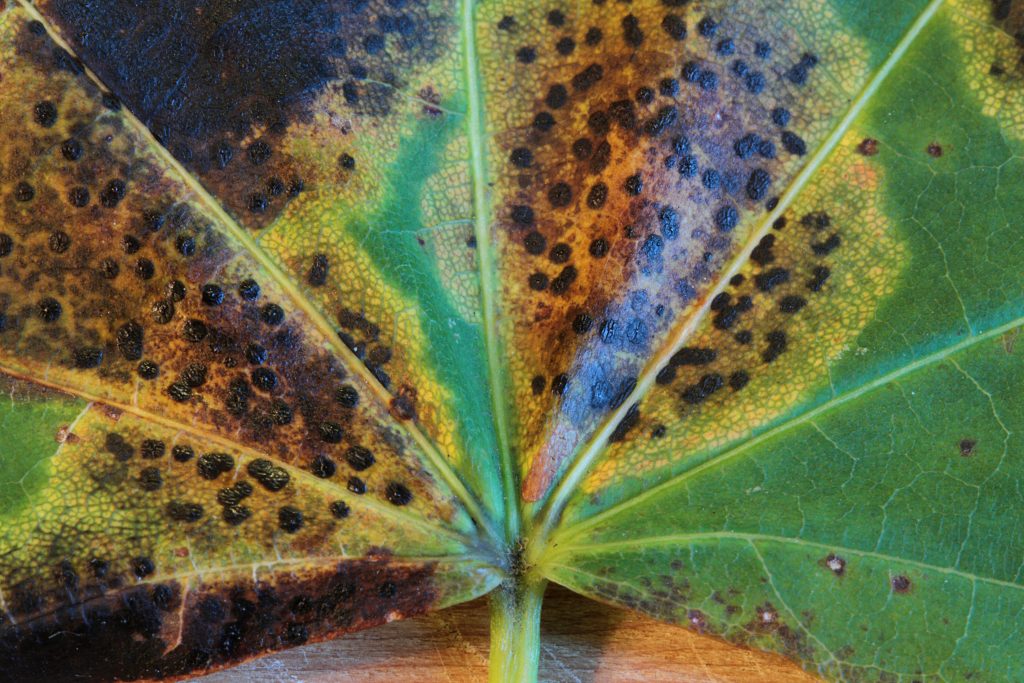
Those raised, glossy black blotches on Norway and Manitoba maple — anywhere from a pencil dot to the size of a loonie, often with a yellow halo — are tar spot, a fungus called Rhytisma acerinum. It infects the new leaves in spring during wet weather, then sits there developing all summer until the spots turn black and obvious in August. Which is why it always seems to appear overnight.
It is a leaf disease and nothing more. It does not enter the wood, it does not travel to the trunk, and it does not kill trees. A maple can carry tar spot on every leaf for years and keep putting on growth. Norway maple is by far the most affected species in Ottawa, which matters because Norway maple is planted up and down half the older streets in this city.
The brown crumpled ones are anthracnose
Anthracnose is the other one out there this year, and it is the one causing the early leaf drop. Instead of tidy black dots you get irregular brown blotches that follow the leaf veins, often starting at the edge and working in, with the leaf curling as it dies. Maple, ash, oak and sycamore all get their own version of it.
Anthracnose also infects in cool wet spring weather, and a wet spring and early summer is exactly what makes a bad anthracnose year. Cornell Cooperative Extension arborists reporting on the same outbreak across the lower Great Lakes this month called it “really more of a cosmetic issue” and expect affected trees to leaf out normally again next year. That matches what we see here.
The honest caveat: a tree that dumps a third of its leaves in mid-August loses six weeks of photosynthesis it was going to use to stock up for winter. One year of that is a nuisance. Three or four in a row on a tree that is already stressed is how a slow decline starts.
How to tell which one you have
- Raised, shiny, jet black, sharply round, yellow ring around it — tar spot. Leaf stays otherwise green.
- Dull brown, irregular, following the veins, leaf curling and dropping — anthracnose.
- Brown and crispy only at the leaf edges and tips, whole tree evenly affected — leaf scorch, which is a water problem, not a fungus.
- One branch or one side browning while the rest of the tree looks fine — stop guessing and get it looked at. A single dying limb is a different conversation than a leaf disease.
The real problem is under the tree, not on it
Leaves are the thing everybody notices. Saturated soil is the thing that puts trees on the ground.
Roots need air. Waterlogged soil has none, and after a summer like this one the fine feeder roots in the top 30 cm have been drowning off and regrowing in cycles since June. Worse, wet soil has a fraction of the holding strength of dry soil. A root plate that anchored a mature tree through every windstorm of the last twenty years does not necessarily anchor it this fall.
That is not theoretical here. Much of Ottawa west and south — through Barrhaven, Riverside South and out toward Nepean — sits on Leda marine clay, which goes greasy when it is loaded with water. Trees on that ground do not shed limbs in a storm. They tip whole, root plate and all. We saw the pattern after the 2022 derecho and again after every saturated spring since.
The trees to look hard at before the fall winds:
- Anything with a lean that is newer than you are sure about, especially with cracked or heaved soil on the upslope side of the base.
- Dense, unthinned crowns — a wet summer grows a lot of leaf, and a heavy crown on soft ground is a sail on a loose anchor.
- Dead ash. Still everywhere, still shedding limbs unpredictably, and the root systems on long-dead ash are rotted through. How to tell if your ash is finished →
- Anything already growing in a low spot that held standing water this summer.
Root rot: the trees that will not come back
A season of saturated ground is ideal conditions for Phytophthora and Armillaria root rot. These are not leaf problems. They kill roots and the base of the trunk, and by the time the crown shows it, a lot of the damage is done.
What it looks like from the ground: a crown that thinned this summer and did not fill back in, undersized off-colour leaves across the whole tree rather than in patches, dieback starting at the tips of the upper branches, and sometimes a dark weeping stain or sunken area low on the trunk. Ash, birch, spruce and white pine on heavy ground are the ones we lose most often to it here.
Mushrooms at the base are worth a photo
Wet years produce a lot of fungus and most of it is harmless soil fungus feeding on old organic matter. Two kinds are not, and you should send us a picture of either:
- Tight clusters of honey-coloured mushrooms at the trunk base or over the root flare, usually in fall — likely Armillaria, actively killing roots.
- A hard shelf or bracket growing straight out of the trunk or root flare, woody, often reddish-brown on top with a white underside — a decay conk. That means the wood inside is already being consumed, and the tree can be structurally unsound while looking perfectly green on top.
Mushrooms out in the lawn, away from the tree, are not the same thing and are not a concern.
What to actually do this fall
- Rake and remove the fallen leaves. Both fungi overwinter in the leaf litter and reinfect from below in spring. This is the single most effective thing a homeowner can do, it is free, and it genuinely reduces next year’s severity. Bin them or put them in the green bin — do not compost diseased leaves on site.
- Stop watering established trees. Obvious, but people are on irrigation timers that have not been touched since May.
- Do not fertilize a stressed tree. Pushing soft new growth into fall on a tree with compromised roots makes it worse, not better.
- Walk the base of every large tree. Look for heaved soil, a new gap between trunk and ground, mushrooms, or a lean. Photograph anything you are unsure about — a photo from today is worth a lot in six months.
- Get heavy crowns thinned before the wet snow. A crown thinning in October costs a fraction of an emergency callout in January, and on soft ground it is the cheapest structural insurance there is. How we approach pruning →
What we would not do
We would not spray for tar spot or anthracnose. Fungicides only work preventatively, applied at bud break in spring, and on a mature shade tree you cannot get coverage on the whole canopy anyway. Anyone quoting you a treatment for tar spot in August is selling you something that cannot work — the infection happened in May.
We would not remove a tree over spotted leaves. Tar spot is not a reason to take a tree down, and a healthy maple that looks rough in August will be fine in June. Removals should be decided on structure, decay and risk, not on how the foliage looked at the end of a bad summer.
And we would not top a tree to “reduce the sail.” Topping produces weakly attached regrowth that fails harder in the next storm. Proper crown reduction and thinning does the job without wrecking the tree.
If you want eyes on it
Quotes are free and we would rather look at a questionable tree in September than climb over it in January. For anything urgent — a fresh lean, a heaved root plate, a limb over the house — call (613) 715-0103; the phone is faster than the form. For the rest, a couple of photos gets you a straight answer.
Get a free quote → · How removal works → · What to do after a storm →
Quick answers
Will tar spot kill my maple?
No. Tar spot is a leaf disease. It does not enter the wood or the roots, and trees carry it year after year without decline. It is an appearance problem, and in a wet year it is unavoidable.
Should I spray for tar spot or anthracnose?
Not on a mature yard tree. Fungicides have to go on preventatively at bud break to do anything, and full coverage of a large canopy is not practical. Raking and removing the fallen leaves does more for next season than any spray applied now.
My tree dropped half its leaves in August. Is it dying?
Usually not. Early leaf drop after a wet spring is normally anthracnose, and the tree should leaf out normally next year. It becomes a real concern if it repeats several years running, if the crown thins and does not fill back in, or if dieback starts at the branch tips — that pattern points at the roots, not the leaves.
How do I know if my tree is leaning more than it used to?
Look at the ground, not the trunk. A lean the tree grew into over decades has soil that sits flat and undisturbed at the base. A lean that is moving shows cracked or heaved soil on the high side, a gap opening between the trunk and the ground, or exposed roots lifting on one side. Any of those after a summer like this one should be looked at before the fall winds.
Photo: tar spot (Rhytisma acerinum) on a Norway maple leaf, by Cephas, CC BY-SA 3.0, via Wikimedia Commons. Ottawa rainfall figures via CTV News Ottawa (Aug. 5 and Aug. 12, 2026); watershed conditions via the Rideau Valley Conservation Authority (Aug. 10, 2026).
Max Trees publishes its prices: see the full 2026 price schedule for Ottawa tree removal, pruning and stump grinding.