
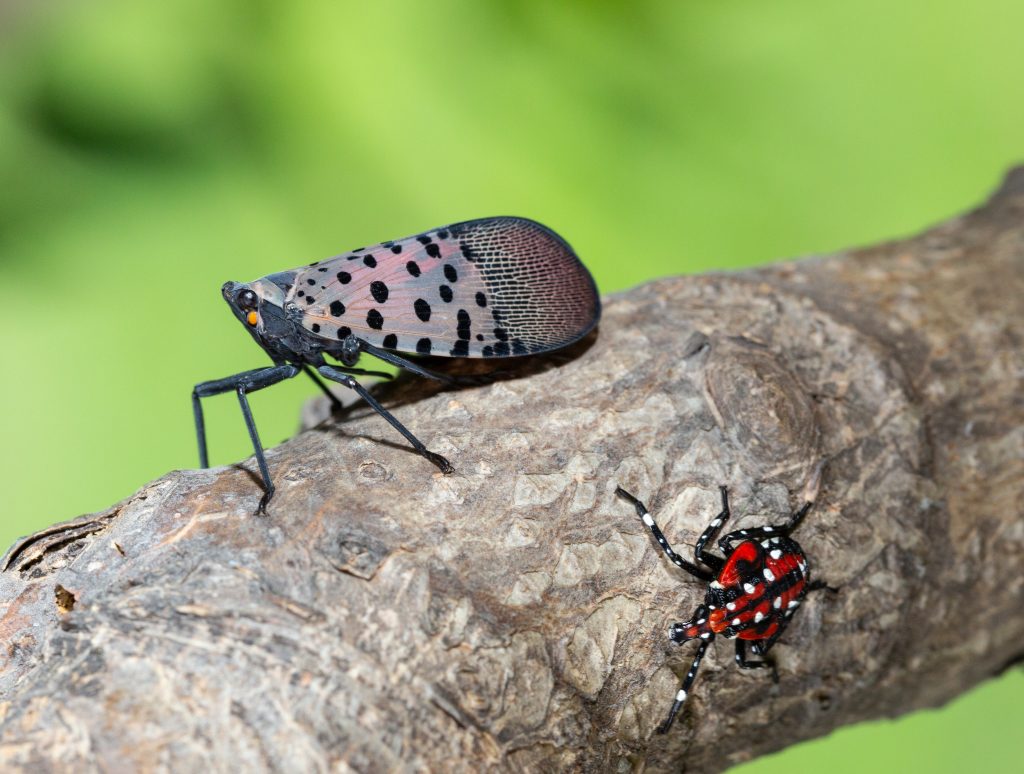
The Canadian Food Inspection Agency confirmed Canada’s first spotted lanternfly on 15 September 2026, in Windsor, Ontario. That is the far southwestern corner of the province — about as far from Ottawa as you can get and still be in Ontario. Movement restrictions are in place around Windsor, and the CFIA says surveillance is ongoing to work out how big the infestation is.
The question that follows is whether it is here. The federal record says no: there is exactly one Ottawa entry in the CFIA’s observation table, from January 2023, and it was a dead insect. This page is what that record says, what this bug does to a tree, and what is worth looking at in your own yard over the next few weeks.
What the CFIA confirmed, and what the words mean
The agency uses four words for four different things, and coverage tends to flatten them into one. They are the difference between a scare and a problem.
- Sighting — reported, followed up, no specimen found.
- Interception — a real specimen confirmed by the CFIA, but not found on an official survey. Usually something that arrived on a truck.
- Detection — a live insect confirmed in the Canadian environment through an official survey.
- Established population — evidence of a breeding population, confirmed by survey.
Windsor is a detection — the first time this insect has been confirmed alive in the Canadian environment by a federal survey, which is why it is real news. It is not the last category. The CFIA’s own observations page, updated the same day, still reads: “We have not confirmed any established populations of spotted lanternfly in Canada.”
None of that means relax — it has been regulated here since 2018, so the government has been expecting it for eight years. It means the honest description today is “confirmed in one city at the far end of the province,” not “in Ontario’s trees.”
Ottawa’s only record is one dead insect, and it is nearly four years old
We read the table rather than the headlines. Ottawa appears once: January 2023, interception, dead. A specimen the CFIA confirmed but did not find on a survey — something that arrived on a vehicle and did not survive. There is no live record here, ever.
The live records sit in two clusters and neither is near us: Windsor-Essex, and Niagara. Both are the deep southwest.
The closest live sighting in the whole table is not in Ontario at all — Montreal, on Nuns’ Island, July 2025. And the most repeated entry of all is Saint-Bernard-de-Lacolle, Quebec: the border crossing on the truck route out of New York State, where the CFIA has intercepted this insect over and over.
That pattern is the useful part. This is not an infestation creeping up the province like a weather front; it turns up wherever freight stops.
What it does to a tree, and what it does not do
It is a sap feeder. It punctures bark and stems and drinks, on more than 100 species of trees and plants. Then comes the sentence most of the coverage leaves out, and it is the CFIA’s own: “significant impacts from this feeding have only been observed on grapes.”
The Invasive Species Centre says the same: it damages and kills grapevines, and the real casualty is the grape and wine industry. For growers, nurseries and vineyards this is serious. For the maple in your front yard, on the evidence that exists, it is not the same kind of problem.
What you would notice on a tree is mess rather than death. As they feed they excrete honeydew, a clear sticky liquid that pools at the base of the tree and on whatever sits under it. It grows sooty mould, draws bees and wasps, and as it ferments it smells like vinegar. Sticky patio furniture and wasps round the trunk is the homeowner version of this insect.
We say that plainly because the comparison people reach for is emerald ash borer, and it is the wrong one. Ash borer kills the tree, reliably, and it is already everywhere here. This is a different shape of problem.
Right now is egg-laying season, and eggs are how it would arrive
This is worth reading now rather than next spring. Adults are most active in September and October, when they mate and lay, and the egg masses go on almost anything.
What to look for — descriptions from the CFIA, the Invasive Species Centre and the USDA, not from us; we have never seen one in this city:
- Egg masses — about an inch long, 30 to 50 eggs. Fresh ones look like wet grey putty; older ones go dull brown, exactly like a smear of cracked mud. On trunks, bricks, stone, fences, grills, equipment and vehicles, from September through winter.
- Adults — roughly an inch long, half an inch wide. Wings folded, pinkish-grey with black spots; open, the hind wings are scarlet and the body yellow with black bars. They gather in numbers rather than singly.
- Nymphs — spring and summer only. Black with white spots early, red with black and white spots later.
One detail worth sitting with: the CFIA states the egg masses can survive winter temperatures and hatch in spring. The assumption that our winter will handle this for us is not supported.
It does not fly here. It gets driven here.
The CFIA’s list of how this insect moves is a list of human activity: cargo and containers, camping gear, patio furniture, trucks and cars, and the movement of plants and plant material — nursery stock, logs and firewood. The USDA calls it a hitchhiking pest and notes it lays eggs on grills, trailers, firewood, outdoor furniture, bikes and toys.
Which makes the Ottawa action small and specific. If you have driven back this autumn from Pennsylvania, New York State, Niagara or Windsor-Essex, look over the vehicle, the trailer and anything that rode outside. Check what has sat in the yard before it goes into the garage for winter.
And firewood, again. We write this every year about a different insect and it stays true: do not bring firewood home from somewhere else. Buy it where you burn it.
One more thing the CFIA asks for, and almost nobody does it: reports of tree-of-heaven — not the insect, the tree. It is a preferred host, and the agency targets those locations when it goes looking. Light brown to grey bark, and very long leaves — one to four feet, each made of many small leaflets. If you have one, log it on iNaturalist or EDDMapS.
What we would not do
- We would not spray anything. There is no live spotted lanternfly on record in this city. A preventative insecticide programme for an insect that is not here costs money and kills the ones that are.
- We would not put sticky bands or traps on a tree. Same reason. There is nothing here to catch, and a band wrapped round a trunk is not a harmless object.
- We would not take a tree down over this. Not on a federal record saying significant impacts have only been observed on grapes, and not for an insect with no live record anywhere in eastern Ontario.
- We would not assume a spotted bug is this one. Native insects look close enough that the USDA publishes a lookalikes guide. Photograph it rather than deciding, and send it in if unsure.
- We would not read “not here” as “cannot arrive.” We made that point last week about the pests Ottawa keeps getting warned about, and this is the one that moved column. Windsor is a real change in the picture.
If you do think you have found one, the process is short. Photo or video. Catch the insect, or scrape the egg mass, into a sealable container. Report it to the CFIA immediately, with an accurate location. Colin Cassin, the Invasive Species Centre’s executive director, gave the reason for the hurry when the Windsor find was announced: the earlier an invasive species is detected, the better the chances of reducing its spread.
If you want eyes on it
Report the insect to the CFIA, not to us; going straight to them is faster. But if something on your tree worries you and you cannot tell what it is, we will look.
Quotes are free and photos are usually enough to start: one shot of the whole tree, one close-up of the problem. If a limb or a tree looks like it is about to come down, do not wait on email — call (613) 715-0103.
Get a quote · Tree removal · Pruning
Quick answers
Is the spotted lanternfly in Ottawa?
Not on the federal record. The CFIA’s observation table lists Ottawa once — January 2023, a dead insect intercepted, not found on a survey. There has never been a live record here. The first confirmed detection anywhere in Canada was 15 September 2026, in Windsor.
Will the spotted lanternfly kill my maple tree?
There is no evidence that it will. It feeds on the sap of more than 100 plant species, but the CFIA states that significant impacts from that feeding have only been observed on grapes. What a homeowner would notice is honeydew, sooty mould and wasps rather than a dying tree.
What does a spotted lanternfly egg mass look like?
About an inch long and holding 30 to 50 eggs. A fresh one looks like wet grey putty; an older one turns dull brown and looks like a smear of cracked mud. They are laid in late summer and autumn on tree trunks, bricks, stone, fences, grills, equipment and vehicles, and they can survive winter and hatch in spring.
Who do I report a spotted lanternfly to in Canada?
The Canadian Food Inspection Agency, immediately, through its online reporting form. Take a photo or video first, and catch the insect or scrape the egg mass into a sealable container if you can, with an accurate location. The CFIA also asks people to log tree-of-heaven, a preferred host, on iNaturalist or EDDMapS.
Photo: adult spotted lanternfly, Stephen Ausmus, USDA Agricultural Research Service — public domain, via Wikimedia Commons. Sources: Canadian Food Inspection Agency, Spotted lanternfly — Spot it? Snap it, catch it and report it and Spotted lanternfly observations in Canada (both last modified 17 September 2026) for the Windsor detection of 15 September 2026, the movement restrictions, the observation table and the Ottawa entry, the four observation categories, the 100-plus host species, the grapes-only impact statement, the spread pathways and the tree-of-heaven request; Invasive Species Centre, Invasive Insect, Spotted Lanternfly, Detected in Ontario and Canada for the First Time (published 17 September 2026) for the life-stage descriptions, the honeydew and sooty mould detail and the quotation; United States Department of Agriculture, Animal and Plant Health Inspection Service, Spotted Lanternfly (last modified 26 August 2025) for the adult and egg-mass measurements, the hitchhiking surfaces, the fermented odour, tree-of-heaven as preferred host and the lookalikes guide. Written 25 September 2026 — this is a live and changing situation, so check the CFIA pages for the current position before acting on anything here.
Taking wood to the cottage this fall? Read what the federal firewood rule actually says for Ottawa: moving ash firewood out of the CFIA’s emerald ash borer regulated area is prohibited all year, cottage trips included; non-ash firewood can only leave the area through a CFIA-approved facility, so a private household has no legal route out with any species; yard waste is under the same rule; but most of eastern and central Ontario (Renfrew, Lanark, Frontenac, Leeds and Grenville, the Kawarthas, Muskoka) is inside the same regulated area as Ottawa, so most cottage trips never cross the line.
Related: which tree pests are actually in Ottawa and which are not (the federal survey numbers for Asian longhorned beetle, oak wilt and hemlock woolly adelgid) · how to tell if your ash has emerald ash borer, the one pest that is here and does kill the tree · the Ottawa tree care calendar for what September and October are actually for · our published prices if a tree does have to come out for another reason.
Max Trees publishes its prices: see the full 2026 price schedule for Ottawa tree removal, pruning and stump grinding.
Update, 26 October 2026: on 23 October the CFIA confirmed an established spotted lanternfly population in Essex County and put a regulated area in place (Essex County, Windsor, Pelee, Chatham-Kent). The “not established anywhere in Canada” line above was true on 25 September and is now behind the record. Ottawa’s entry did not change: still one dead insect, January 2023.