
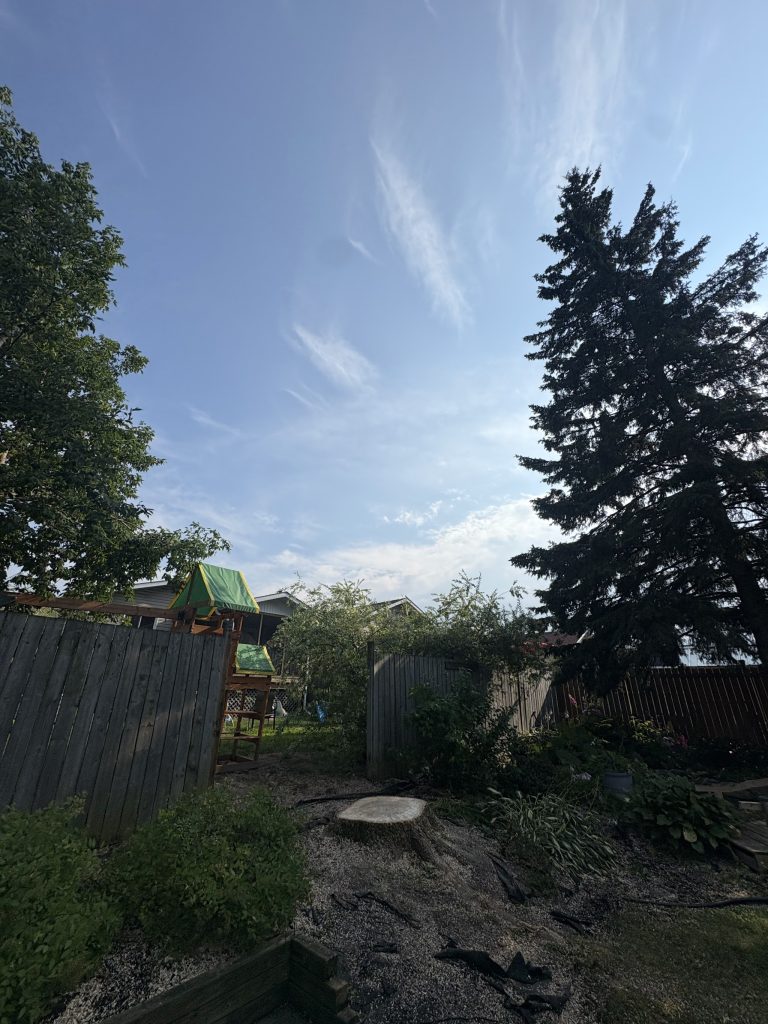
Standing water over a tree’s roots for seven days or less will not hurt most trees. What does the damage is the stretch of airless, waterlogged soil that comes afterwards — and whether your tree shrugs that off or dies of it depends almost entirely on what species it is.
Ottawa has just come through a summer wet enough to make that worth asking about your own yard. So here is which trees minded it, which ones did not notice, what you would see if one of yours took a hit, and why you will probably not see it until next year.
The rivers are still high. Your yard is a different question.
As of this week the Rideau Valley Conservation Authority still has the Rideau River under a Water Safety Statement — in its own words, “high flows, unstable banks … Flooding is not expected.” The statement behind that index, Rainy summer leads to elevated flows, water levels across Rideau Valley watershed, was published on 10 August 2026 and is still the current one six weeks later. The Lower Ottawa River index reads Normal.
That is a fact about rivers. It is not a fact about the low corner of your back lawn. Almost no Ottawa yard sat under standing water this summer. What a lot of yards had instead was clay that never got a chance to drain between rains, which is a slower, quieter version of the same problem. The research on flooded trees is the best guide anyone has to it — as long as you are honest about the difference, which most of what you will read online is not.
Roots do not drown. They suffocate.
Roots need air in the soil, and water fills the same spaces the air was in. Iowa State University Extension states the mechanism plainly: “If oxygen cannot penetrate to roots, trees may exhibit symptoms associated with flooding.” Nothing about the leaves is the starting point. It all happens under the grass.
Two numbers from that same source are worth writing on the back of your hand. The first: “Even flood-sensitive trees will escape injury if flood waters recede in seven days or less.” The second, for the species that cannot take it — they “suffer severe injury or die if flood waters persist over their roots for one month or less.” A month is not a long time. A summer of ground that never dries is considerably longer than a month.
And the line that actually applies to this city is the one about what happens after the water has gone: “Flood waters will eventually recede but soils will undoubtedly remain wet for a long time. Saturated, poorly-drained soils may pose the greatest hazard for trees.” The only cure on offer is one nobody controls. Iowa State calls warm, dry weather “the only cure for this chronic and potentially deadly soil condition.” There is no product for this.
The trees in Ottawa yards that mind it most
Iowa State’s flood-intolerant list — species that suffer badly when their roots stay wet — reads like an inventory of half the mature trees in this city:
- Most pines and spruces. This is the one that catches people out. A row of blue spruce along a fence line is the single most common mature planting in suburban Ottawa, and conifers are near the bottom of the tolerance list. Wet feet is a real way to lose one.
- Sugar maple. Ottawa’s signature tree and one of the least forgiving about drainage. The Norway maples on the older streets are a different species and a different story.
- Red oak and white oak. Slow to show it and slow to recover. An oak that had a bad summer often looks completely normal until the year after next.
- Linden and black walnut. Both common enough in older yards to be worth naming.
The list also carries tulip tree, redbud and yellow buckeye, which are rare enough here that most readers can skip them.
The ones that will not have noticed
At the other end, Iowa State classifies a set of species as flood-tolerant, “surviving as many as two growing seasons with their root systems under water”: silver maple, red maple, green ash, honeylocust and eastern cottonwood among them. In the middle sit the moderately tolerant ones, which have “actually survived an entire growing season of flood conditions”: hackberry, hawthorn, boxelder — the Manitoba maple in half the back lanes in this town — river birch, American elm and sycamore.
Two caveats before you relax about any of them. Green ash is on the tolerant list, and that is close to meaningless in Ottawa, because ash here is being killed by something else entirely — see our guide to emerald ash borer. And a tolerant species with a rotten trunk is still a tree with a rotten trunk. Tolerance buys a tree time in wet ground. It does not fix anything else that is wrong with it.
What the damage looks like, and why you have probably not seen it yet
The symptoms Iowa State lists are “leaf chlorosis (yellowing), downward curling of leaves, leaf drop, and branch dieback.” Yellowing, curling, dropping early, then twigs and small branches dying back from the tips. None of that is specific to wet soil, which is exactly why it gets misread every autumn.
The trap is timing. A tree runs on stored energy, so a root system that spent the summer short of oxygen usually looks fine until the following spring, when it has to push a full crown of leaves on a smaller root system than it had last year. Thin growth, small leaves, dead tips in the top — those are next May’s symptoms of this summer’s weather. If one of your trees is already showing it, that tree was in trouble before the rain started, and it is worth reading why one tree drops early when the street does not. If the complaint is spots and blotches on maple leaves rather than the tree’s shape, that is a leaf disease and a much smaller problem — that is covered in our guide to black spots on maple leaves.
What we would not do
- We would not fertilize it. Feeding a tree with a damaged root system pushes top growth the roots cannot supply. If a tree had a hard summer, the last thing it needs is to be told to grow faster.
- We would not water it. Obvious when it is written down, less obvious in September when every piece of tree advice online tells you to water. Established trees in Ottawa have had plenty this year.
- We would not fill in the wet low spot with topsoil. This is the one that quietly does real harm. Iowa State notes that silt and sand deposited more than three inches deep over roots “may impede movement of oxygen” — and a load of topsoil spread to level a soggy corner is deeper than three inches nearly every time. You would be treating a shortage of air by burying the roots that need it.
- We would not prune a stressed tree this autumn beyond taking out anything actually dead or hanging. Pruning is a wound and a demand for regrowth at the same time. See pruning for the timing.
- We would not take a tree down on the strength of one bad season. A tree that yellowed early after the wettest summer anyone here remembers is not automatically a tree with a problem. Wait for spring and look at what it does then. The exception is a tree whose roots are the suspect part — soft ground, a lean that has moved, a lifted root plate on one side. That is a stability question, not a health question, and it does not wait for spring.
If you want eyes on it
Quotes are free and we will look at photos. Two or three shots of the whole tree from far enough back to see the shape, plus one of the base of the trunk where it meets the ground, answer most of these questions without anyone driving out.
If a tree is leaning further than it was, if the ground on one side has lifted, or if anything is over a house, a driveway or a line, call (613) 715-0103 rather than sending an email. Soft ground and a big crown is the combination that puts trees over in a November wind, and that one is worth a phone call today.
Contact us · Tree removal · Pruning
Quick answers
Can too much rain kill a tree in Ottawa?
Yes, but slowly and selectively. Roots suffocate when water fills the air spaces in the soil, and Iowa State University Extension reports that flood-intolerant species can suffer severe injury or die if water sits over their roots for a month. Species that tolerate it can survive a full growing season or more with wet roots. A wet summer on well-drained ground is a non-event; the same summer on heavy clay is not.
Which trees handle wet soil worst?
Most pines and spruces, sugar maple, red and white oak, linden and black walnut are all on the flood-intolerant list. Spruce is the one worth worrying about in Ottawa simply because there are so many of them in suburban yards, often in the lowest corner of the lot where the water collects.
Should I water or fertilize a tree after a very wet summer?
Neither. The soil already holds more water than the roots can use, and fertilizer pushes the tree to grow a bigger crown on a root system that has just been damaged. Leave it alone, keep the mulch ring in good order, and look at it again in spring.
When will I know if my tree was hurt by the wet weather?
Usually next spring, not now. Trees run on stored energy, so a root system that spent this summer short of oxygen tends to look normal until it has to push a full set of leaves in May. Thin, undersized leaves and dead tips at the top of the crown next spring are the signs to watch for.
Photo: Max Trees — a backyard removal in Ottawa with the neighbouring spruce left standing. Sources: Rideau Valley Conservation Authority, Current Conditions, read 23 September 2026 (Rideau River flood index: Water Safety Statement; latest statement published 10 August 2026). Jeffery Iles, Iowa State University Extension and Outreach, Effects of Flooding on Trees & Shrubs, last reviewed June 2024, for the tolerance rankings, the seven-day and one-month figures, the symptom list and the three-inch sediment figure. No Ontario or federal source carrying an equivalent species-by-species tolerance ranking could be confirmed, so the rankings above are cited to Iowa State by name rather than presented as local guidance.
The tree in the wet back corner of half the lots in Ottawa: should a Manitoba maple stay or come out? The answer turns on what is standing underneath it, not on the species. It grows fast on weak, brittle wood, so limbs come down in wind and wet snow and tight forks split rather than bend; Ontario lists it as invasive because it seeds itself everywhere, which is a reason not to plant one, not an instruction to remove a sound one over open lawn. The boxelder bugs on the sunny wall are not killing it, and cutting it down does not reliably get rid of them.
Max Trees publishes its prices: see the full 2026 price schedule for Ottawa tree removal, pruning and stump grinding.
Related: how to tell a settled lean from a failing root plate after a wet summer · what to do for a tree planted this year before winter (check the soil before watering) · the Ottawa tree care calendar (September is the month to skip for shaping cuts) · our published prices if you want us to look at it.