
Whether your Manitoba maple stays or comes out is decided by what is standing underneath it, not by what the species is called. Ontario’s own tree guide puts the lifespan at up to 60 years and notes that the species “is considered an invasive species across much of its range.” That is a warning about planting one. It is not an instruction to cut down the one already in your yard.
This is the question we get every autumn, once the leaves are off and you can finally see what the tree is made of. Two Manitoba maples the same size, on the same street, can honestly get two different answers — and the thing that decides it is not the tree.
First, make sure that is what you have
It is the easiest maple in Ottawa to identify, because it does not look like a maple at all.
- Compound leaves. Instead of one broad maple leaf you get 3 to 9 leaflets strung along a central stalk 5 to 12 centimetres long. The province calls it the only native maple with divided leaves. People regularly mistake a low sucker for poison ivy.
- Keys that curve inward. Joined pairs of winged seeds hanging in drooping clusters, the wings 30 to 50 millimetres long and hooked toward each other.
- Bark that changes with age. Light greyish-brown and smooth when young, darker and furrowed later.
- Seedlings everywhere. Along the fence line, in the gravel, out of the eavestrough. That is the tell most people notice first.
- Size. Ontario gives 20 metres tall and a trunk up to 75 centimetres across. A big one in a back corner is usually near the top of that.
The wood is the whole problem
Everything difficult about this tree comes back to one thing. It grows fast, and it builds cheap wood to do it.
The University of Florida’s extension service has published on Acer negundo since 1993 and lists the drawbacks in one line: brittle, weak wood, short life, susceptibility to boxelder bug, and trunk decay. Its structure table reads growth rate: fast, breakage: susceptible to breakage, and pruning requirement: needed for strong structure. It tells readers plainly not to plant one as a street tree, and notes that in some cities planting it is outright illegal.
In an Ottawa yard that reads as limbs down in wind and under wet snow, and forks that split instead of bending. Pruning does not fix weak wood. It can take sail off a long limb, and that is all it can do.
“Invasive” here means it plants itself
The word scares people into cutting down a healthy tree, so it is worth being exact about it.
Ontario records Manitoba maple as native in the far northwest of the province, and probably native along the Grand, Thames and Sydenham floodplains in the south. It is now widely distributed throughout Ontario, including all of Southern Ontario. That spread is the invasive part. It got everywhere by seeding itself into ground nobody was watching.
What it means for you is narrow: pull the seedlings along your fence while they are still the thickness of a pencil. It does not make the mature tree a hazard, and it does not oblige you to remove it. Those are two separate decisions and they should stay separate.
The bugs on the south wall are not killing the tree
Every autumn somebody calls about the black-and-red bugs massing on the sunny side of the house and asks whether the Manitoba maple has to go.
Boxelder bugs feed mainly on the seeds produced by female boxelders, and Clemson’s extension service is blunt that this feeding rarely causes significant damage — they are not considered economically important plant pests. Penn State’s page, updated in June 2026, describes the autumn behaviour exactly as you are seeing it: they gather in large numbers on the south side of trees, buildings and rocks, then work into cracks and crevices looking for somewhere to spend the winter.
Here is the part nobody wants to hear. Penn State also records that in heavily infested areas the bugs are associated with ash and other maples as well. Taking out your tree is not a guaranteed fix if a neighbour has one. Sealing the gaps they are getting in through is what actually works, and that is a caulking gun, not a chainsaw.
When we would leave it standing
A Manitoba maple earns its place when it is doing a job nothing else will do.
- The wet back corner. Ontario notes it tolerates wet conditions once established, and Florida’s soil tolerance list includes extended flooding. That is why it is the tree still standing in the soggy corner of half the lots in this city. We went through which species cope with a wet year and which do not — this one copes.
- Nothing underneath it. Open lawn, a back fence, a field edge. A limb that lands on grass is a cleanup, not a claim.
- Shade you already have. It is twenty years ahead of anything you would plant to replace it. That is worth something real.
- Screening and windbreaks. The province notes they are commonly planted in windbreaks. A row along a rural line fence is doing work.
When we would take it out
The case for removal is almost always about position, not species.
- It is over something that matters. A roof, a driveway with a car on it, a deck, a pool, a play structure.
- Tight forks with bark squeezed into them. Two or three trunks leaving the same point in a sharp V, with a seam of bark buried in the join. That is the classic failure on this species, and it goes all at once.
- Soft wood at the base. A cavity, a hollow that takes your arm, mushrooms at the root flare, or a trunk that sounds wrong when you knock it.
- It has already started shedding. One limb down is information. Two is a pattern.
- Surface roots lifting hardscape. Florida notes the species can form large surface roots. Once a walkway or a patio is moving, the argument is usually over.
If it ticks two of those and it is over a target, call rather than read. We do not tell you a specific tree is safe from a web page, and a Manitoba maple over a roof is not something to leave until spring.
If it does come out this autumn, the hole is a decision too. The City’s Forestry Services began its fall caliper planting on 1 October and runs to mid-November, weather permitting. That is roughly your own window as well, while the ground is still open. Where not to put the replacement matters more than which one you pick.
What we would not do
- We would not top it. Cutting the crown back to stubs on a weak-wooded tree grows a crop of fast, poorly attached regrowth on a decaying frame. It is the worst thing you can do to this species in particular, and we do not do it on any species.
- We would not remove a healthy one because somebody called it a weed tree. That is a plant-list opinion applied to a standing tree. If it is sound and nothing is under it, it stays.
- We would not spray for boxelder bugs. They are not damaging the tree, and your problem is on the wall, not in the crown.
- We would not sell you cabling on a decayed union. Hardware supports sound wood. On an old Manitoba maple with a rotten fork it postpones a removal and charges you twice.
- We would not quote it from the kerb. The decision lives at the base of the trunk and inside the fork, and neither is visible from the street.
If you want eyes on it
Quotes are free, and Max does every one of them himself. If you would rather not book a visit yet, send photos — the whole tree from far enough back to see the top, the base of the trunk, and a close-up of any fork you do not like the look of. That is usually enough to say whether it is urgent.
If a limb is hanging, or the tree has moved, call (613) 715-0103. The minimum charge on any work is $160 + HST, and that covers everything.
Get a quote · Tree removal · Pruning
Quick answers
Is a Manitoba maple a bad tree?
It is fast-growing, weak-wooded and short-lived, and Ontario lists it as invasive across much of its range. That makes it a poor tree to plant. It does not make every standing one a problem. A sound Manitoba maple over open lawn is fine where it is.
Will cutting it down get rid of the boxelder bugs?
Not reliably. The bugs feed mainly on the seeds of female boxelders, but Penn State Extension records them associating with ash and other maples as well, so a neighbour’s tree will keep them coming. Sealing the cracks they use to get indoors does more than removal does.
Do I need a permit to remove a Manitoba maple in Ottawa?
Possibly, and it has nothing to do with the species. The rules here turn on trunk diameter and where the tree stands, not on what kind it is. Our Ottawa tree removal permit guide walks through it, and we check before any removal.
Can it be pruned instead of removed?
Sometimes. Shortening a long limb over a roof takes load off a weak attachment and can buy years. What pruning cannot do is make brittle wood strong or repair a decayed fork, so it is a way to manage a sound tree, not a substitute for taking out a failing one.
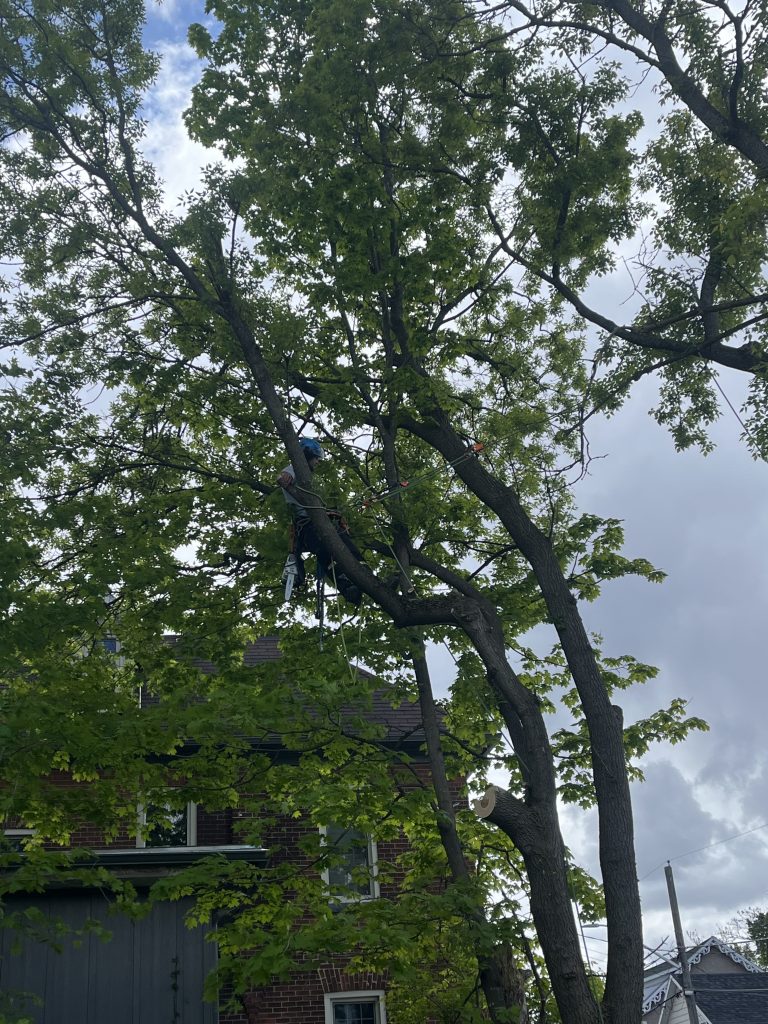
Photo: Max Trees, Ottawa — our own job photo. Sources: Government of Ontario, “Manitoba maple” (published 18 July 2014, updated 17 October 2023) · UF/IFAS Extension ENH-179/ST020, “Acer negundo: Boxelder” (original publication November 1993, revised December 2018) · Penn State Extension, “Boxelder Bug” (updated 24 June 2026) · Clemson Cooperative Extension HGIC 2409, “Boxelder Bugs” (published 13 August 2010) · Councillor Glen Gower, “Fall 2026 tree planting update” (1 October 2026).
Related: which trees cope with a wet year and which do not · what a support cable can and cannot do for a tight fork · how to tell a settled lean from a failing one · the Ottawa tree permit rule, which turns on trunk diameter and location, not species, and how it applies in your neighbourhood · where not to put the replacement · if a limb is hanging or the tree has moved · included bark, topping and the other terms, defined · our published prices.
Max Trees publishes its prices: see the full 2026 price schedule for Ottawa tree removal, pruning and stump grinding.