
Hydro Ottawa’s own planting guidance is that a tree which will grow past 12 metres should not go under overhead lines at all, and a medium tree — 6 to 12 metres — needs to sit back from the line by the full height it will one day reach. Not the height it is at the nursery. The height it finishes at.
Thousands of free trees are going into Ottawa yards this year, and the tree is the cheap part. The expensive part shows up in twenty-five years, when the thing is tight against the soffit or grown into the service drop and somebody has to pay to take it down. Here is where to put one so that never becomes your problem.
The City is handing trees out right now
There is more free tree stock moving in Ottawa this year than most people realise.
- Plant Your Place — a City of Ottawa programme delivered by EnviroCentre. It aimed at roughly 2,500 trees in 2026, about double its first year, with one free tree per resident, sixteen species to choose from and free planting in priority wards (EnviroCentre, 9 March 2026).
- Trees for Today — Ecology Ottawa, distributing 640 native saplings in 2026 in low-canopy neighbourhoods, with the programme set to reach more communities in the autumn (Ecology Ottawa, 28 May 2026).
- Community plantings — the Rideau Valley Conservation Authority and the Town of Perth are putting 150 native trees into Darou Farm on Saturday 19 September 2026, 10 a.m. to noon, through TD Tree Days (RVCA, 3 September 2026).
The reason for the push is straightforward. The City is working to a 40 per cent canopy target and the urban wards have been going the wrong way — canopy across them fell from 21.5 per cent to 20.6 per cent between 2017 and 2022, fourteen wards losing cover, on figures put to the City’s Environment and Climate Change Committee in September 2025 (Kitchissippi Times, 8 February 2026).
Take the free tree. Just do not let the free part decide where it goes.
The hydro clearances are the part people skip
This is the one that costs real money later, and Hydro Ottawa publishes actual numbers rather than vague advice. From their planting guidance of 20 May 2025:
- Trees under 6 metres at maturity — keep at least 1.5 metres away from hydro poles.
- Trees 6 to 12 metres — plant them back from the lines by a distance equal to their full-grown height.
- Trees over 12 metres — only where there are no overhead restrictions at all. Not under the line, not beside it.
- Underground services — at least 1.5 metres between the root ball and any marked cable.
- Pad-mounted transformers — 3 metres clear in front of the doors, 1.5 metres on the other sides.
There is a safety number in there too, and it applies the day you plant and every day after: if anyone or anything — a ladder, a shovel, a pole pruner — is going to come within 3 metres of a power line, stop and call Hydro Ottawa. That distance is not negotiable and it is not a tree company’s call to make.
The underground figure matters more than people expect, because roots do not stay where you planted them — they sit shallow and spread well past the branch tips, which we went through in our guide on cutting tree roots. Get a locate before you dig, not after.
How far back from the house
There is no published code number for this the way there is for hydro lines, so we will tell you plainly that this is our working rule and not a regulation: find out the mature spread of the species, halve it, and give it that much room from the wall — then add a bit.
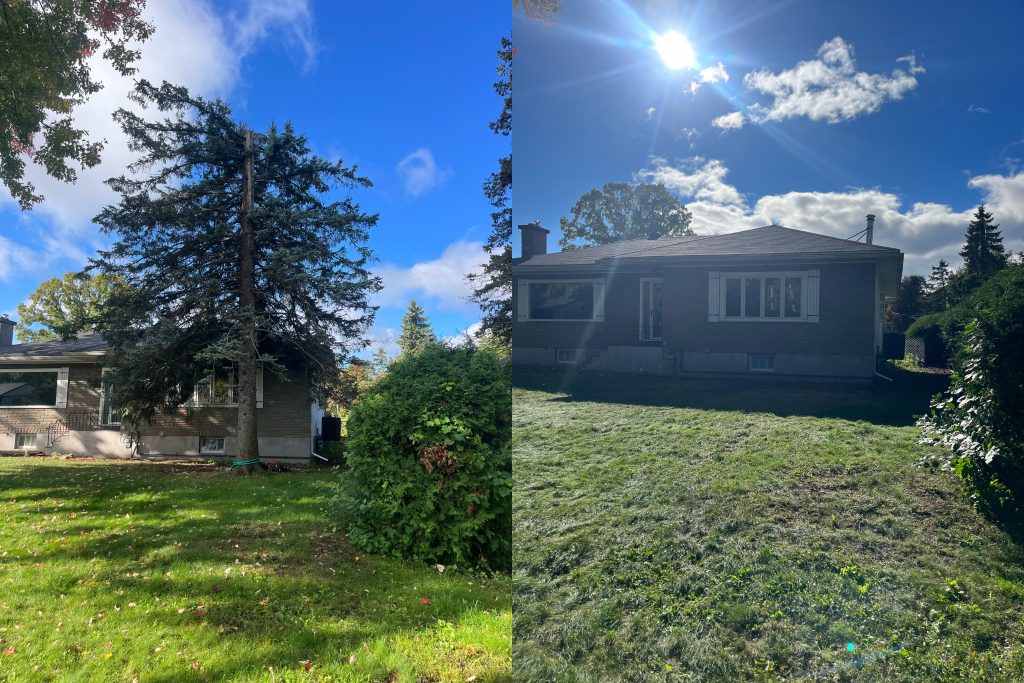
The photo at the top of this page is what that looks like when it goes wrong: a spruce hard against a single-storey house in Ottawa, and the same house after we took it out. Nobody planted that tree against the wall. It went in as a sapling a few metres out, which felt generous at the time.
What actually goes wrong when a big tree ends up too close is dull and expensive. Limbs in the gutters mean paying to prune the same tree every few years forever. There is no working room, so the removal has to be done in pieces and roped clear rather than felled, which is the longer and dearer version of the job. And the roots end up under the driveway.
A small ornamental at 4 metres from the wall is fine. A tree that finishes at 20 metres is not, at any distance most Ottawa lots can offer on the house side.
Now the ash are gone, do not plant one thing everywhere
Ottawa learned this the hard way. Emerald ash borer went through the ash and did not leave much — if you still have one standing, our guide on how to tell if your ash is done covers what to look for.
The standard guard against a repeat is the 10-20-30 rule, set out by Frank Santamour in a 1990 paper for the Metropolitan Tree Improvement Alliance: no more than 10 per cent of one species, 20 per cent of one genus, or 30 per cent of one family across a tree population. It was written for city foresters, but it scales down to a street. If four neighbours have just put in the same free maple, take something else.
The fall window is shorter than people think
Autumn is a good time to plant in this climate, but it is not open-ended. UMass Extension’s guidance on fall planting is that plants need at least six weeks to establish before the ground freezes, which in practice means getting deciduous stock in by mid-October here.
Two things narrow it further:
- Pine and spruce want to go in before the end of September, while the soil is still warm.
- Broadleaf evergreens and yew are better left until spring. Planting those now is a gamble you do not need to take.
Water it going in and keep watering until the ground freezes. A tree that goes into winter dry is the one that does not come back.
What we would not do
We would not plant a big tree under a hydro line and plan to keep it cut back. That is a subscription, not a solution, and it ends in a tree shaped like a fork. We do not top trees, and the crews that will do it are not doing you a favour.
We would not plant a Norway maple. The Ontario Invasive Plant Council lists it as invasive (updated 25 July 2025) on the strength of its shade tolerance, heavy seed production and ability to take hold in almost any soil. It out-competes the native maples.
We would not put a silver or Manitoba maple near the house, the garage or the driveway. They grow fast, which is the selling point, and the wood is soft and brittle, which is the bill after wet snow.
We would not plant straight into fresh stump grindings. After a stump grinding job the grindings are left in the hole as backfill unless removal is specified. That is wood chips, not soil. Dig them out and put topsoil in first.
And we would not prune the new tree to shape in its first autumn. September is already the poorest month on the calendar for pruning, for reasons we set out in our guide on when to prune trees in Ottawa. Let it establish.
If you want eyes on it before you dig
Straight answer on what we do: we do not plant trees. We are the ones who take them out, prune them and grind the stumps — which is exactly why we have opinions about where they go in.
What we can do is look at what is already there before you add to it: whether the mature tree beside the spot is safe to plant under, what is likely to have to come out anyway, and whether a stump needs grinding before you replant. Max is Tree Risk Assessment Qualified (TRAQ) and does every quote himself. Quotes are free, photos are fine to start with, and the minimum charge on any work is $160 + HST, covering everything.
If something is leaning, dropping limbs, or touching a line, do not book it in — call (613) 715-0103. Anything within 10 metres of a power line is the utility’s job first.
Get a quote · Tree removal · Stump grinding
Quick answers
How far from my house should I plant a tree in Ottawa?
There is no code number for it. Our working rule is to look up the mature spread of the species, halve it, and leave at least that much space between the trunk and the wall. A small ornamental is comfortable at around 4 metres out; anything that finishes above about 15 metres does not belong on the house side of a typical Ottawa lot at all.
Can I plant a tree under a hydro line?
Only a small one. Hydro Ottawa’s guidance is that trees maturing under 6 metres stay at least 1.5 metres from poles, trees of 6 to 12 metres are planted back from the lines by a distance equal to their full height, and anything over 12 metres should only go where there are no overhead restrictions. Keep root balls 1.5 metres clear of marked underground cables.
Is it too late to plant a tree in Ottawa this fall?
Not yet, but the window is closing. UMass Extension advises at least six weeks of establishment before the ground freezes, so deciduous stock should be in by about mid-October in this area. Pine and spruce want to be planted before the end of September, and broadleaf evergreens and yew are better held over until spring.
What should I plant now that the ash are gone?
Something your street does not already have. The 10-20-30 rule, from Frank Santamour’s 1990 paper, caps any one species at 10 per cent of a tree population, any genus at 20 per cent and any family at 30 per cent, so that a single pest cannot clear the block the way emerald ash borer cleared the ash. We would avoid Norway maple, which the Ontario Invasive Plant Council lists as invasive.
Photo: Max Trees — a mature spruce standing hard against a bungalow in Ottawa, before and after removal. Sources: Hydro Ottawa, planting near the grid (20 May 2025) (clearances, 3-metre safety zone); EnviroCentre, 9 March 2026 (Plant Your Place, 2,500 trees); Ecology Ottawa, 28 May 2026 (Trees for Today, 640 saplings); Rideau Valley Conservation Authority, 3 September 2026 (Darou Farm planting, 19 September 2026); Kitchissippi Times, 8 February 2026 (canopy figures presented to the Environment and Climate Change Committee, September 2025); UMass Extension, fall planting (six-week window, conifer and evergreen timing); Ontario Invasive Plant Council, Norway maple (updated 25 July 2025); Frank Santamour, “Trees for urban planting: diversity, uniformity, and common sense”, METRIA, 1990 (the 10-20-30 rule).
Max Trees publishes its prices: see the full 2026 price schedule for Ottawa tree removal, pruning and stump grinding.