
If the tree is growing into the main line strung from pole to pole, Hydro Ottawa trims it and it costs you nothing. If it is growing into the smaller wire that drops off the pole and runs to your house, that one is yours. Two wires, two owners, and nearly every argument about who should be paying starts with somebody not knowing which wire they are looking at.
This is about a tree already in contact — branches sitting on a wire, rubbing it in the wind, or grown right around it. Where to put a new tree so this never happens is a different question, answered in where not to plant a tree in Ottawa.
There are two wires above your yard and they belong to different people
Stand at the road and look up. The heavier wires running along the street from pole to pole are the distribution line — the utility’s equipment and the utility’s problem. Then look for the thinner wire that leaves a pole on an angle and lands on the corner of your house, usually above the meter. That is your service wire. On its own vegetation management page, Hydro Ottawa puts the job of keeping vegetation clear of the service wire on the property owner.
There is usually a third and fourth wire on the same route, telephone and cable, strung lower. People point at those and say “it’s only the internet line.” Sometimes they are right. From the ground, on a windy day, looking up into a maple, nobody is right often enough to bet on it.
The main line is Hydro Ottawa’s, and the trimming is free
Hydro Ottawa runs a vegetation programme it describes as trimming more than 60,000 trees a year across its territory, and it maintains vegetation within three metres of an overhead powerline. Its own FAQ puts the money part plainly: it will not charge you if the trimming falls inside that three-metre clearance zone.
So if a branch is into the street line, you do not need us and you do not need a quote. You need a request in to Hydro Ottawa. Reporting it is free, the trim is free, and it is the cheapest tree job available in this city.
What they will not do is prune the rest of your tree while they are there. Line clearance cuts are shaped to push growth away from the conductor, often a V or a C through the crown. It is not a haircut and is not meant to be one. If you want the other side balanced afterwards, that is ordinary pruning and it is yours to pay for.
The wire to your house is yours, and so is the phone call that makes it safe
This is the part most people do not know: you are responsible for the service wire, but you are not expected to deal with it hot.
Hydro Ottawa’s own guidance, in a post dated 24 September 2024, tells homeowners with vegetation on a service wire to contact them and have them “temporarily shut off the electricity so a licensed contractor can safely make the cuts.” Its tree trimming FAQ says the same thing in service terms: submit a tree trimming request and they will schedule an inspection or a temporary disconnection. In their words, “we can arrange a temporary power outage, so your contractor can work safely.”
That is the whole answer for most yards. You book the disconnect, they pull the power for the morning, the work gets done beside a dead wire, and it goes back on. You lose the fridge for a few hours and nothing else.
Make that call first, not last. If you ring us and the disconnect has not been arranged, all we can do is come out, look, tell you to phone Hydro Ottawa, and come back. Two visits for one job.
What we will not do
We will not put a saw into a tree that is in contact with a live conductor. Not for a quick one, not for a customer we like, not because the branch is small.
That is not us being careful for the sake of it. The Electrical Safety Authority’s guideline on pruning trees around powerlines states that members of the public should not prune or remove trees around overhead powerlines at all, and that arborists and landscapers are not qualified to work in the vicinity of energized powerlines and must stay outside the limits of approach. Utility line-clearing crews are trained and authorised for that work. A general tree crew, ours included, is not. Anyone in Ottawa who tells you otherwise is telling you something about how they run their business.
Two more. We will not accept “it’s only the cable line” as fact from the ground — a wire that cannot be identified with certainty is treated as live. And we will not put a date on a removal that only works with the power off until the disconnect is actually booked, because a date depending on a call nobody has made is not a date.
What we will do is the work either side of it: the removal once the wire is dead or the tree is clear of it, the crown work on the rest of the tree, and the stump afterwards.
The distances, in plain numbers
Two sets of numbers get quoted at homeowners, and they answer different questions.
For you, standing in your yard, Hydro Ottawa is simple: stay at least 3 metres (10 feet) from an overhead line on a pole, 6 metres (20 feet) from a line on a metal transmission tower, and 10 metres (33 feet, a school bus length) from any line that is down.
For anyone working, Ontario Regulation 213/91 sets minimum distances by voltage. The Infrastructure Health and Safety Association reproduces the table in its 2022 guidance on working near overhead powerlines:
- Less than 750 volts — 1 metre (3.3 feet)
- 750 to 150,000 volts — 3 metres (10 feet)
- 150,000 to 250,000 volts — 4.5 metres (15 feet)
- Over 250,000 volts — 6 metres (20 feet)
The residential service wire sits in the bottom band; the street distribution line does not. One metre and three metres are very different amounts of room inside a crown, which is exactly why the answer here is a disconnect and not a longer pole saw.
If a line is already down, nobody touches anything
A limb that has taken a wire down is not a tree job yet. Hydro Ottawa’s instruction is to stay at least 10 metres back from the wire and anything it is touching — the tree, the fence, the puddle — call 9-1-1, then call Hydro Ottawa at (613) 738-6400.
Do not drag the branch off the wire. Do not move the car. Do not let the dog out. A conductor lying in wet grass can energise ground you would walk across without thinking, and it does not look like anything.
Once the utility has attended, it becomes a tree job, and the rest of that work — the hangers, the cracked union, the half-tree still standing — is covered in what to do with a fallen or split tree in Ottawa.
If the tree is the City’s, that is a different phone call again
Street trees on the road allowance are not yours, whatever it feels like when you are the one raking them. For a tree on City property, Hydro Ottawa’s own FAQ sends you to 3-1-1, and that is the right number. Where your property actually ends, and whether a tree needs a permit before anything happens to it, is its own subject — covered in do you need a permit to remove a tree in Ottawa.
If you want eyes on it
Send photos. One from the road showing the whole tree and the poles, one from underneath looking up at where the branch meets the wire. That is usually enough to tell you which wire you are dealing with, and whether this is a Hydro Ottawa call, a booked-disconnect job, or something we can do tomorrow with nothing switched off.
Quotes are free. If it is on a wire and you are not sure, call (613) 715-0103 rather than sending an email and waiting. Our minimum charge on any job is $160 + HST, covering everything.
Contact us · Pruning · Tree removal
Quick answers
Who pays to trim a tree away from a power line in Ottawa?
If the branch is within the three-metre clearance zone of the main overhead line, Hydro Ottawa trims it and does not charge you. If it is on the service wire running from the pole to your house, arranging and paying for the work is the property owner’s responsibility. Reporting either one costs nothing.
Can I cut the branch off my own service wire myself?
No. The Electrical Safety Authority’s guideline says members of the public should not prune or remove trees around overhead powerlines. The route that exists for exactly this situation is to ask Hydro Ottawa for a temporary disconnection so a contractor can work with the wire dead. Call them at (613) 738-6400 or submit a tree trimming request.
A branch has brought a line down in my yard. What do I do?
Stay at least 10 metres (33 feet) away from the wire and from anything it is touching, including the tree and any standing water. Call 9-1-1 first, then Hydro Ottawa at (613) 738-6400. Do not attempt to move the branch. Tree work starts after the utility has attended, not before.
The tree is on the City boulevard, not my lawn. Who do I call?
Call 3-1-1 for a tree on City property — Hydro Ottawa’s tree trimming FAQ directs residents there for city-owned trees. If you are not certain where your property line falls, settle that before anyone cuts anything. A tree on the road allowance is not yours to remove.
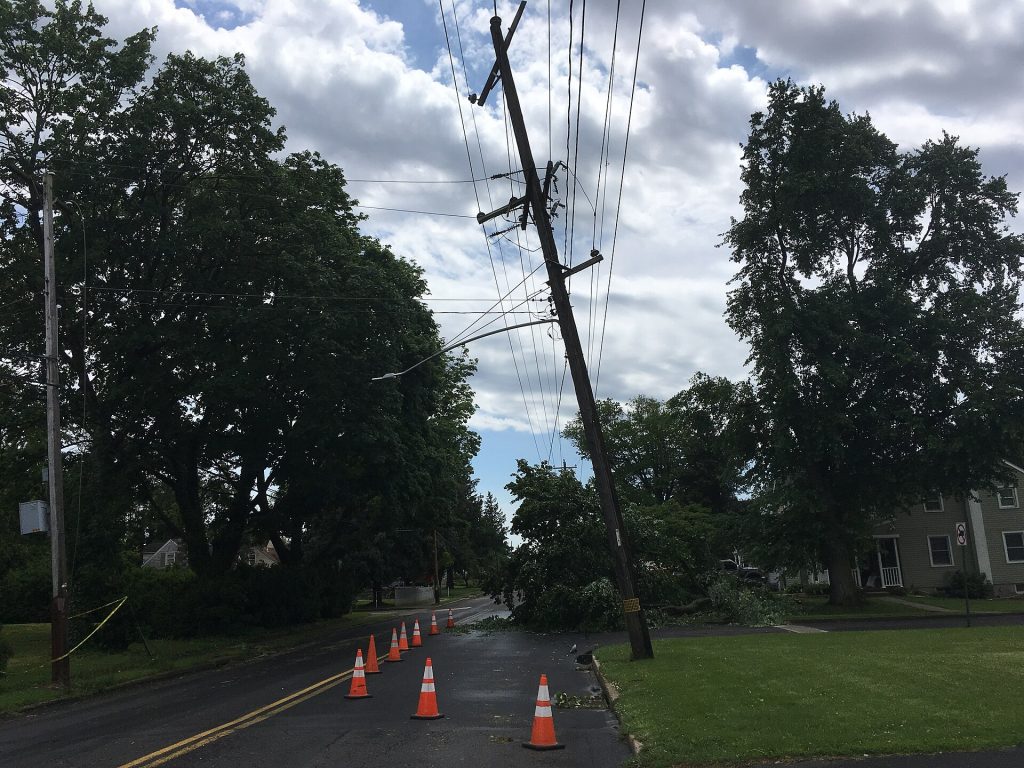
Photo: a leaning pole and power lines pulled down across a residential street after a storm took a tree limb into the wires — Warminster Road, Hatboro, Pennsylvania, 3 June 2020, by Dough4872 — Wikimedia Commons, CC BY-SA 4.0. Illustrative, and not an Ottawa job.
Sources: Hydro Ottawa, vegetation management and tree trimming FAQ, and outdoor and power line safety; Hydro Ottawa, “Pruning for power,” 24 September 2024; Electrical Safety Authority, Guidelines for Pruning Trees Around Powerlines; Infrastructure Health and Safety Association, Working near Overhead Electrical Powerlines & Equipment (W802, 2022), reproducing the minimum distances in Ontario Regulation 213/91, s. 188. Distances and responsibilities confirmed on the issuing bodies’ own pages on 9 September 2026.
Need it dealt with now? See emergency tree removal in Ottawa: what counts as urgent, what a storm callout costs (1.5x the published schedule), and the by-law hazard exemption.
Max Trees publishes its prices: see the full 2026 price schedule for Ottawa tree removal, pruning and stump grinding.