
Ice can increase the weight of a branch by a factor of ten to a hundred. That number explains why a tree that stood through every summer thunderstorm comes apart in a quiet November snowfall. Nothing about the tree changed. The load did.
Every September someone asks us to “thin out” a big spruce so the snow and wind go through it. It sounds reasonable. It is mostly wrong, and in the hands of the wrong crew it makes the tree worse. Here is what actually fails on an Ottawa property in winter, what is worth doing before freeze-up, and what we would not do to your tree for money.
Trees do not break because the wood is weak. They break at the joints.
The research on ice storms is blunt about this. Reviewing why trees fail, Richard Hauer, Les Werner and Jeffery Dawson put it plainly: “the wood strength of sound branches matters less than the ability of a tree to withstand breakage at branch junctures.” Their predictors of failure are weak branch junctures showing included bark, decaying or dead branches, unbalanced crowns and shallow rooting.
Purdue’s forestry extension service says the same in its August 2026 piece on storm damage: “poor architecture and development, such as codominant stems and included bark in branch junctions, predisposes branches to failure.” It also separates the two winter loads — “axial loading from snow or ice accretion” pressing straight down, and “lateral, side loading from wind” pushing across.
So in September we are not really looking at the tree. We are looking at a short list of joints, asking which lets go first and what is underneath it.
Included bark is the thing worth learning to see
A codominant stem — two trunks of roughly equal size instead of one — is common here on maple, ash and spruce, and on its own not a crisis. What makes it one is included bark, where the two stems grew so tightly together that bark is trapped in the union instead of wood.
- Look for the seam, not the angle. A tight V with a dark line down it is the bad one. A strong union is a U with a raised ridge of wood in the crotch.
- Look for movement. A union that has started to open usually shows a crack running down the stem below it.
- Look at what is under it. A codominant spruce over a shed is a shed problem. The same tree over the back lawn can wait.
August already told you which branches are in trouble
Ottawa took a run of hard summer storms this year. CTV News Ottawa reported on 13 August 2026 that the previous night’s storm cut power to thousands of homes, flooded roads and damaged hundreds of trees across the city. Most people cleared what landed on the lawn and moved on.
The problem is what did not land. A limb that tore part-way out and lodged in the crown is still up there. A union that cracked but held is still up there. Neither heals. They wait for the first load heavy enough to finish the job — in this city, a wet November snow or freezing rain. The province’s own forest health reporting, updated 13 May 2026 and covering the 2025 season, records a late-March ice storm across Eastern and Southern Ontario and notes the area of blowdown “increased from 2024 at over 6,086 hectares.”
So the useful September job is not cosmetic. It is walking the property and finding what August left behind: hangers, torn stubs, fresh cracks, brittle dead wood. If something already came down, our guide on what to do with a fallen or split tree covers the part on the ground.
What we would not do
We would not top your tree. Not before winter, not for a “height reduction”, not at any price. Illinois Extension’s February 2026 write-up is a fair summary of why: the stubs left behind “are slow to seal, if they seal at all (especially if they are more than 2 inches in diameter),” which lets in insects and decay, and the shoots that replace the removed top “are weakly attached, making them prone to breaking.” Within a few years the tree is back to its original height anyway. You pay to turn a tall tree into a shorter one with a decaying core and a crown full of weak attachments. Then you pay again.
We would not lion-tail it. Most people have no word for this, so it gets sold as “thinning”: stripping the interior branches out and leaving the foliage bunched at the ends. The Kansas Forest Service’s March 2021 fact sheet says what that does — it puts “more weight distribution on the ends of the branch instead of equally along the entire branch,” and “with end-heavy branches, a tree will not sway and is more susceptible to wind and ice damage.”
We would not strip a crown out chasing wind resistance. Purdue’s guidance is that ordinary maintenance — correcting weak attachments, removing dead wood — does more for storm resistance than heavy thinning. Kansas puts a ceiling on it: no more than 20% of a canopy should come off in any single pruning. Anyone offering to open up half your spruce before the snow is describing damage, not a service.
What is worth doing before freeze-up
In the order we would spend your money:
- Get the dead wood and the hangers out. Dead limbs break first and are the most likely thing to hit something. Highest value per dollar on almost every property we look at, and it is ordinary pruning.
- Reduce the over-extended laterals. Not the whole crown — the two or three long, heavy limbs reaching over a roof, a driveway or a fence. Shortening those back to a proper lateral takes the leverage out without gutting the tree.
- Deal with the bad union. A codominant stem with included bark over something that matters is either a cabling and bracing job or a removal job. It is not a pruning job and it will not fix itself.
- Take out the tree that was always coming out. Already dead, already leaning badly, already hollow at the base — winter will not improve it. We would rather do that removal on frozen ground in January than clear it off your roof in a storm.
Most structural pruning is better done in the dormant season than in September, for reasons set out in our guide on when to prune trees in Ottawa. Dead wood and hangers are the exception. Those come out whenever you find them.
Cedar hedges are a separate problem
Iowa State’s extension service, in guidance last reviewed February 2024, names what breaks first: “multi-stemmed evergreens, such as junipers and arborvitae, and weak-wooded deciduous trees.” Arborvitae is eastern white cedar, which is most of the hedges in this city.
A cedar hedge does not usually snap. It splays. Snow loads the top, the stems bend outward, and by spring the hedge is open down the middle and will not close, because cedar does not regrow from brown wood. The cheap fix is the one Iowa State recommends: tie the uprights before the snow, so the plant holds a cone shape that sheds instead of catching. Soft strapping spiralled up, not wire. On a young hedge it takes twenty minutes. If yours is already too tall to tie, that is a hedge trimming conversation for next season.
When the snow is already sitting on it
- Brush upward, never down. Shake the branch gently or sweep the snow off with a broom, lifting. Iowa State is explicit: never brush downward, because you risk breaking branches that are already bent and stressed.
- Leave ice alone. Frozen wood is brittle and you will take the branch with it. Wait for it to melt.
- Not off a ladder, and not near a wire. A tree touching a power line is not a tree company’s job until the utility has attended.
If you want eyes on it
Quotes are free and Max does every one himself. He is Tree Risk Assessment Qualified (TRAQ), which is the relevant thing here — the question before winter is which joints fail first and what sits underneath them. Photos are a fine place to start: one shot of the whole tree from far enough back to see its shape, plus a close-up of any union you are unsure about. Our minimum charge is $160 + HST and it covers everything.
For anything urgent — a limb hanging over a driveway, a crack you can see opening — call (613) 715-0103 rather than emailing. Otherwise send the photos over and we will tell you whether it needs doing before the snow or whether it can wait.
Quick answers
Does thinning a tree protect it from snow and wind damage?
Not much, and done badly it makes things worse. Purdue’s extension guidance is that removing dead wood and correcting weak branch attachments does more for storm resistance than heavy thinning. The Kansas Forest Service sets a ceiling of no more than 20% of the canopy in any single pruning, and warns that stripping interior branches leaves end-heavy limbs more vulnerable to wind and ice, not less.
How much extra weight does ice actually put on a branch?
A lot. The review by Hauer, Werner and Dawson on why trees fail in ice storms states that ice accumulation can increase branch weight by a factor of ten to one hundred times. They also note that the United States National Weather Service defines an ice storm as at least 0.625 cm (a quarter inch) of accretion on exposed surfaces.
Should I knock snow off my trees after a storm?
Snow, carefully. Ice, no. Iowa State Extension advises gently shaking the branch or brushing snow off with a broom by sweeping upward, and specifically warns never to brush downward, because you risk breaking branches that are already bent and stressed. Ice should be left to melt rather than knocked off. Do none of it from a ladder.
Is it too late in the year to get tree work done in Ottawa?
No. Dead wood and hanging limbs can be removed at any time of year and are the most useful thing to deal with before winter. Structural pruning on most species is better left to the dormant season, and removals are often easier once the ground is frozen, because heavy equipment does far less damage to a lawn in January than in October.
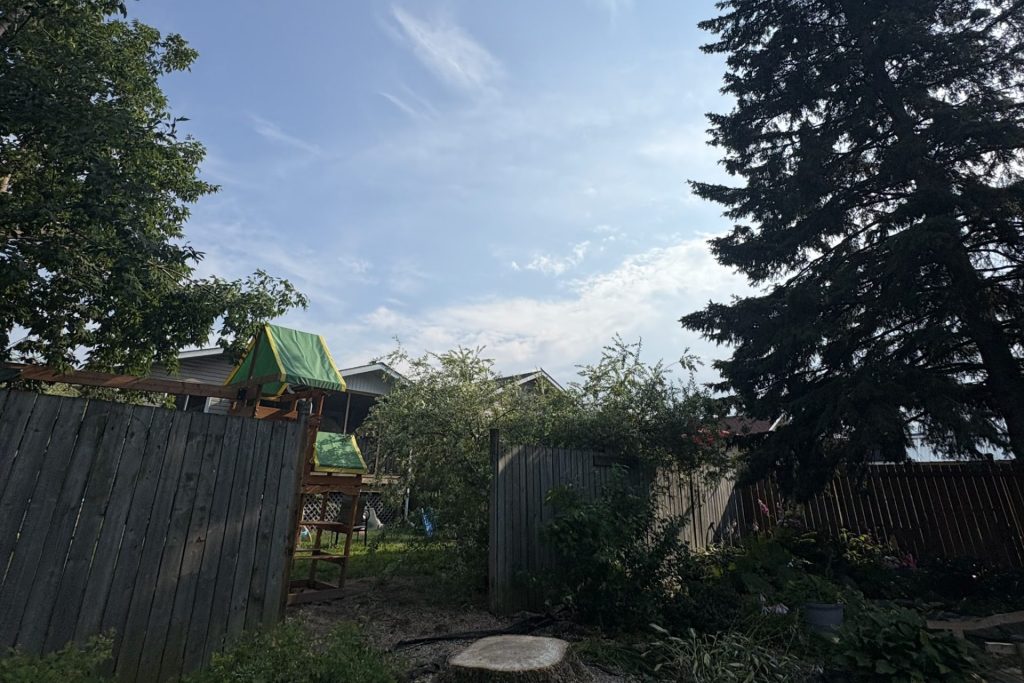
Photo: Max Trees — a mature spruce standing at the back fence of an Ottawa yard. Sources, with dates read off each publisher’s own page: Richard J. Hauer, Les P. Werner and Jeffery O. Dawson, “Why Trees Fail During Ice Storms” (presented 2008; hosted by the Connecticut Department of Energy and Environmental Protection) · Purdue University Forestry and Natural Resources Extension, “Trees and Storms: Understanding the Damage”, 12 August 2026 · University of Illinois Extension, “Tree topping is never a good option”, 27 February 2026 · Tim McDonnell, Kansas Forest Service, “Lion Tailing and its Impact on Tree Health” (MF3551), March 2021 · Aaron Steil, Iowa State University Extension, “How to Prevent Ice and Snow Damage on Trees and Shrubs”, last reviewed February 2024 · Government of Ontario, Forest health conditions, page updated 13 May 2026, reporting the 2025 season · CTV News Ottawa, “Ottawa residents cleaning up after latest summer storm knocks out power, brings down trees”, 13 August 2026.
Need it dealt with now? See emergency tree removal in Ottawa: what counts as urgent, what a storm callout costs (1.5x the published schedule), and the by-law hazard exemption.
Max Trees publishes its prices: see the full 2026 price schedule for Ottawa tree removal, pruning and stump grinding.