
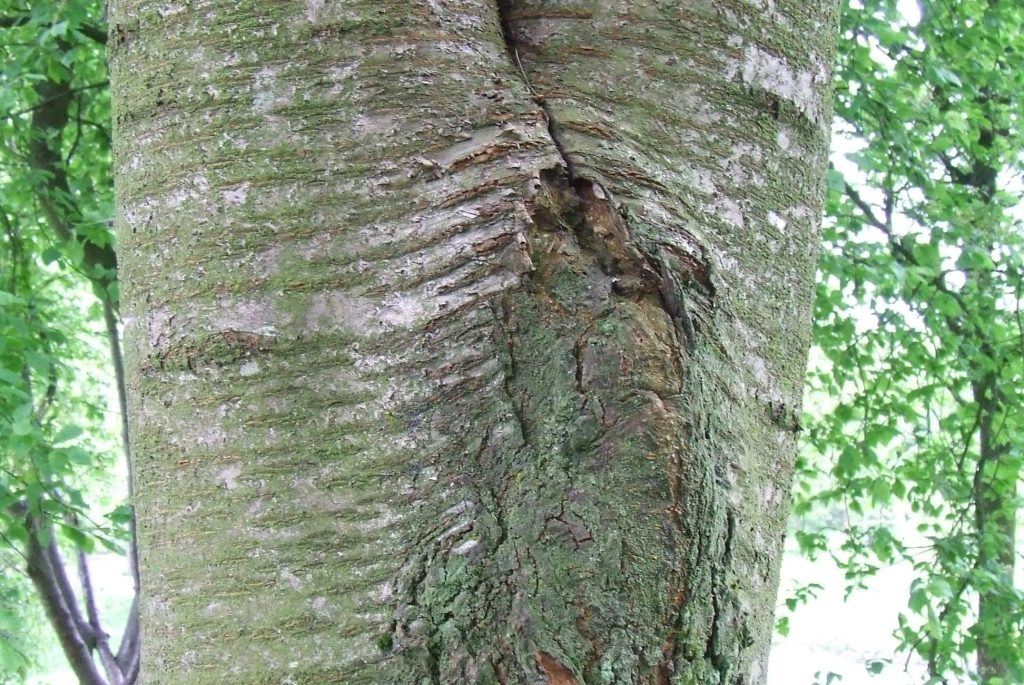
A cable will not hold your tree together. It limits how far two stems can pull apart, and that is the whole of what it does. Purdue’s extension guidance states the limit plainly: “Cabling and bracing do not eliminate risk of tree failure.” Anyone who tells you otherwise is selling hardware.
Last week we wrote that a split trunk with bark trapped in the union, standing over something that matters, is either a cabling job or a removal job — and then did not say which. This is which: what a support system does, the trees we will put one in, the trees we will not, and what a cable costs you every year afterwards.
The problem is the union, not the branch
Most big-tree failures in Ottawa backyards are not rotten wood. They happen where two stems of roughly equal size meet, split down into the trunk, and take half the tree with them.
Purdue Extension describes why that shape is weak: “Codominant stems or ‘V-crotch’ branch unions are structurally weak compared to a single stem or those with proper branch aspect ratios and spacing. The weakness is due to lack of connective tissue anchoring a stem to the tree trunk and the presence of included bark between the stems.”
Included bark is the part worth learning. When two stems grow tight against each other, bark gets trapped in the join instead of wood. The tree looks like it has a solid fork. It does not — it has two stems leaning on a seam of dead bark.
E. Thomas Smiley measured it on red maple in Arboriculture & Urban Forestry in 2003. Unions with included bark broke at roughly 20 per cent less force at 10 cm stem diameter, and about 14 per cent less at 25 cm, than clean ones. His conclusion went further than his numbers: “all codominant stem junctions should be considered weak.”
How to see it from the ground
You do not need to climb anything. Stand back and look at where the trunk divides:
- U or V. A rounded U with a wrinkled ridge of bark in the crotch is usually sound. A tight, narrow V with no ridge is the one to worry about.
- A seam running down the trunk. Included bark often shows as a dark line or crease continuing below the fork, sometimes for a metre or more.
- A bulge or rib beside the join. That is the tree laying down extra wood to compensate, which means the union is moving.
- Anything already cracked. An open crack at a fork, especially one weathered grey, is not a monitoring situation.
Silver maple, Manitoba maple, willow, ash and Norway maple fork like this constantly in Ottawa yards, and so do plenty of the spruce planted three feet from a foundation in the 1970s.
What a cable actually does
A support system goes in high in the crown, well above the union, and restricts how far the two stems can move apart in wind or under snow. That is it. It does not glue the union, add strength to the wood below it, or reverse anything that has already happened.
Bracing is different. Braces are rods installed through the stems at or near the union, used where there is already a crack to hold closed. Writing in Tree Care Industry magazine in October 2024, Andy Jones and Nick Greenwood put the distinction cleanly: “Proactive bracing aims to prevent potential mechanical failures, while reactive bracing is applied after a tree begins to show signs of mechanical issues, such as cracking, splitting or tearing.”
There is a written standard for this work — ANSI A300 Part 3, covering installation and maintenance of tree support systems including cabling, bracing and guying. It exists because hardware has to be sized to the tree and set at the right height. Guessing at either is how a cable becomes a hinge.
When we will put one in
Four things have to be true before a cable is the answer:
- The tree is otherwise healthy. Good crown, reasonable growth, no real dieback. Hardware on a declining tree is money spent on a schedule you do not control.
- The wood around the union is sound. Cables anchor into the stems. If the stems are decayed, there is nothing to anchor to.
- There is something underneath worth protecting. A house, garage, driveway, deck or a neighbour’s property. A forked silver maple at the back of an acre lot needs nothing.
- You will keep up the inspections. This is the one people skip, and it is not optional.
Purdue frames the first question the way we do before quoting: is this a reasonable treatment for this tree, or are you preserving a tree that should come out?
What we would not do
We turn down more cabling work than we take on:
- We will not cable a tree to avoid removing it. If it is coming out within a few years anyway, a cable is money spent twice, and we will say so in the yard rather than after you have paid for hardware.
- We will not cable a decayed union. Mushrooms or a conk at the base or the fork changes the conversation entirely. Which fungi at the base actually matter →
- We will not cable a dead or dying ash. Ash killed by emerald ash borer loses strength fast and unpredictably, and hardware in that wood is false security. How to tell if your ash is finished →
- We will not top it instead. Cutting the tops off two codominant stems to “reduce the load” is the cheap version of this job, and it gives you a worse tree with weaker regrowth at every cut.
- Do not do it yourself. Rope or chain wrapped around two stems girdles both, and tightens as the tree grows. Threaded rod from the hardware store is not rated for this.
One more we hand straight back: if the tree is leaning, the question is the roots, not the union, and a cable in the crown does nothing about it. Telling a settled lean from a failing one →
A cable is a commitment, not a repair
This gets left out of most quotes, so here it is in full. Purdue on maintaining an installed system: “Ground inspections should be conducted annually for loose hardware or adjustments. Usually, every three years the support system should be inspected by an arborist who ascends the tree.” And on lifespan: “Be prepared to have the system inspected regularly, then perhaps replaced after 7–10 years.”
So: a look from the ground every year, someone in the tree every three, a replacement in the second decade. A cable installed and forgotten for fifteen years is worse than none, because you spent those years walking under the tree believing it was handled.
If you will not keep that up — and plenty of people reasonably decide they will not — the honest options are removal now, or accepting the risk with your eyes open. Both are defensible. Hardware you ignore is not.
Why this is a September decision
Two reasons, both local. The first is load: wet snow and freezing rain are what pull codominant stems apart in this city, and that season starts in about eight weeks. Work done now is done before the load arrives. What actually fails on an Ottawa property in winter →
The second is this year in particular. CTV News Ottawa reported on 12 August 2026 that the summer went into the record books as the wettest in the city’s history. Wet summers grow heavy crowns, and a heavy crown on soft ground puts more leverage on every weak union in the tree. Forks that held for twenty years are being asked to do more this winter than last.
If you want eyes on it
Send a photo of the fork and one of the whole tree from far enough back to see its shape, and we will tell you whether it is a cabling conversation, a pruning conversation or a removal conversation. Quotes are free and Max does every one himself — he is Tree Risk Assessment Qualified (TRAQ). Our minimum charge is $160 + HST and it covers everything.
If a stem has already split and part of the tree is hanging or resting on something, do not wait for a quote — call (613) 715-0103. And if any part of it is within 10 metres of a power line, that is the utility’s call before it is ours.
Get a quote → · Pruning → · Tree removal →
Quick answers
Does cabling make a tree safe?
No. It reduces how far two stems can move apart, which lowers the chance of that union failing. Purdue Extension states that cabling and bracing do not eliminate the risk of tree failure. A cabled tree still needs looking at, and it can still fail somewhere else.
How long does a tree cable last?
Purdue’s guidance is a ground inspection every year for loose hardware, a climbing inspection roughly every three years, and replacement after about seven to ten years. Growth matters too — the tree keeps thickening around the hardware, so a system that fitted in year one will not in year fifteen.
Can I cable a tree myself with rope or chain?
No, and the failure mode is worse than doing nothing. Anything wrapped around a stem girdles it as the tree grows, strangling the tissue that moves water and sugar. Hardware also has to be sized to the tree and set high enough in the crown to control movement — which means working at height in a tree you already know is compromised.
Is cabling cheaper than a removal?
The first invoice usually is. The ten-year cost often is not, once you count annual inspections, a climbing inspection every third year, and replacing the system in the second decade. If the tree is coming out within five years anyway, cabling it is paying twice. We will give you both numbers and let you decide.
Photo: an included bark junction in a wild cherry (Prunus avium), by Duncan R Slater, CC BY-SA 3.0, via Wikimedia Commons; cropped. Sources: Lindsey Purcell, Purdue Extension, “Large Tree Cabling and Bracing” (FNR-550-W), September 2017 · E. Thomas Smiley, “Does Included Bark Reduce the Strength of Codominant Stems?”, Arboriculture & Urban Forestry 29(2), March 2003 · ANSI A300 Part 3 (2013), Supplemental Support Systems, scope as published by the Tree Care Industry Association · Andy Jones and Nick Greenwood, “An Introduction to Supplemental Tree-Support Systems, Part 3”, Tree Care Industry, 9 October 2024 · CTV News Ottawa, “It’s the wettest summer in Ottawa history”, 12 August 2026.
Related: emergency tree removal in Ottawa if the union has already failed (hung limbs are same-day work; storm callouts 1.5x the published schedule) · our published prices for the removal side of the decision · how to choose a tree service in Ottawa.
Terms used on this page (included bark, codominant stems and cabling) are defined in plain language in the Ottawa tree service glossary.
The tree in the wet back corner of half the lots in Ottawa: should a Manitoba maple stay or come out? The answer turns on what is standing underneath it, not on the species. It grows fast on weak, brittle wood, so limbs come down in wind and wet snow and tight forks split rather than bend; Ontario lists it as invasive because it seeds itself everywhere, which is a reason not to plant one, not an instruction to remove a sound one over open lawn. The boxelder bugs on the sunny wall are not killing it, and cutting it down does not reliably get rid of them.
Max Trees publishes its prices: see the full 2026 price schedule for Ottawa tree removal, pruning and stump grinding.