
If the mushrooms are growing out of the wood — the trunk, the root flare, the buttress roots — something is digesting the inside of your tree. If they are growing out of the grass a metre away, they usually mean nothing at all. That one distinction settles most of the calls we get in September.
Ottawa has just come through the wettest summer in its recorded history, and early September is when wood-decay fungi push out their fruiting bodies. So a lot of Ottawa yards are about to grow things they have never grown before. Here is how to tell which ones are worth a phone call and which ones you can mow around.
Grass or wood — answer that before anything else
Look at what the mushroom is attached to. Not near. Attached to.
Mushrooms coming up through open lawn are usually feeding on thatch, on old organic matter, or on buried wood you cannot see. The University of Maryland Extension is direct about it: they are not harmful to lawn health, there is no practical or permanent way to get rid of them, and they do not need to be removed. It also flags the case people get wrong — buried roots and stumps from trees taken out months or years ago will keep producing mushrooms in lawn where there is no visible wood at all.
That last one matters here. If you had a tree removed and the stump ground out two or three summers ago, the root system is still down there rotting. Mushrooms over that old root run are the system working, not a warning. Pick them if small kids or a dog might eat them. Otherwise leave them — they collapse in a week.
Honey-coloured clusters at the base in the fall
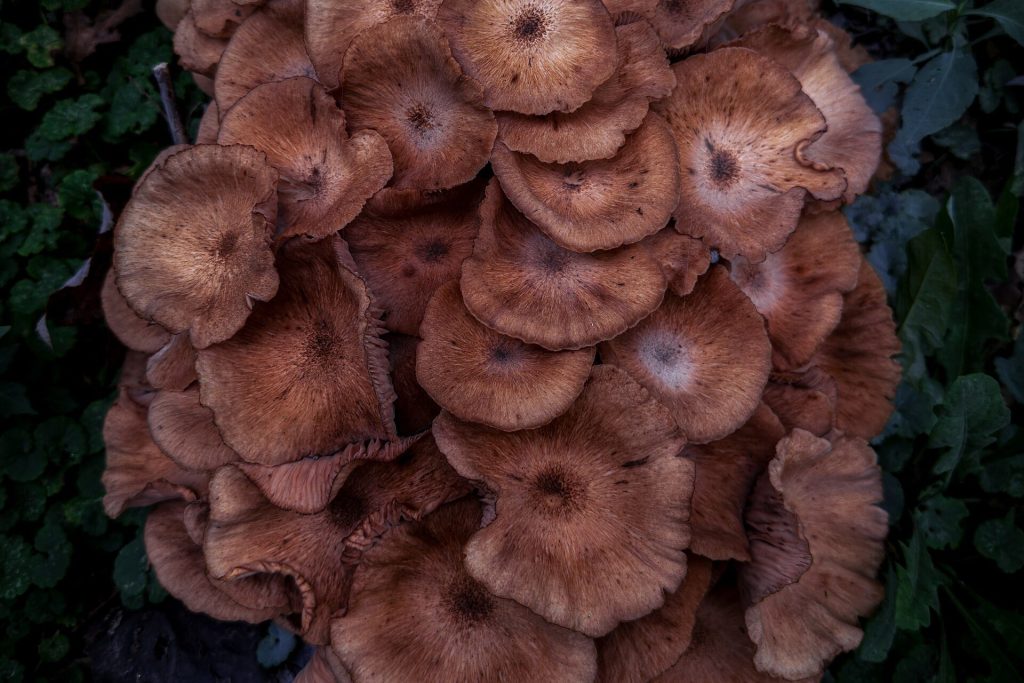
This is the one worth knowing by sight. Armillaria root rot — honey fungus — produces clusters of overlapping honey-coloured mushrooms at the base of a tree in the fall, per the Government of Ontario. A tight tufted mass, dozens at a time, right at the flare or just off it on the soil.
What to look for alongside them:
- Thin upper canopy. Ontario lists sparse foliage up top, undersized leaves, and twigs dying back. The tree looks like it is running out of steam from the top down.
- A soggy white sheet under the bark. Ontario calls it a mycelial mat. The University of Minnesota Extension describes the same thing as flat white fans between the bark and the wood at the base.
- Black shoestrings in the soil. Thick black fungal strands that can run about 3 m (10 feet) out from an infected tree or stump, per Minnesota.
- White, soft, stringy wood at the base, with decay that can extend roughly 1.8 m (6 feet) up the trunk.
Two honest points. Ontario says the fungus turns aggressive when growing conditions are already poor — drought, compacted soil, wounded roots; a tree whose roots were cut for a driveway five years ago is a candidate. And Ontario states plainly that affected trees are probably not curable. Nobody sells a fix for this.
Host list is broad: maple, oak, birch, poplar, spruce, pine, cedar. That is most of an Ottawa yard.
A hard shelf on the root flare is a different problem
Not a mushroom shape — a woody shelf, growing straight out of the trunk near the ground or out of a surface root a few feet away. That is usually a Ganoderma. The UMass Extension fact sheet puts fruiting from late August through October, maturing late September into early October — which is exactly now. Reddish-brown on top, a bright white growing edge, white pores underneath. Oaks, maples, beech and honeylocust are the usual hosts.
The reason we care more about this one than about a lawn mushroom is location. It is decaying the roots and the lower trunk — the part holding the tree up. UMass is careful about the timeline though: the white rot works slowly, and infected trees may stay stable for many years before cavities form. So a conk is not a demolition order. It is a thing to start tracking.
Practical version: photograph it with something for scale, note the date, and photograph it again next September. UMass recommends documenting conk production annually, and that is the most useful thing a homeowner can do here.
Two more worth recognising
- Brittle cinder. The one people walk past for years. Missouri Botanical Garden describes it as light grey with a whitish border in spring and early summer, then for the rest of the year a bumpy blackened crust that looks like the trunk was scorched and snaps crisply if you break a piece off. It sits on the lower trunk near the soil line and on the buttress roots, reads as a tar smear or an old burn mark, and gets ignored. It should not be — MOBOT notes an infected tree can carry a full crown while the inside is badly decayed, which means failure without much warning. Beech, maple, linden and hackberry mainly. No effective control.
- Chicken of the woods. Bright orange and yellow overlapping shelves, hard to miss, July through October. UMass calls it a brown rot causing dramatic reductions in wood bending strength, mostly on oaks but also maple and beech, and notes extensive decay can be present with no external symptoms at all. People eat this one. That does not make it good news for the tree it came out of.
What a mushroom does not tell you
It does not tell you how much wood is gone. The fruiting body is the fruit; the decay column is inside the trunk and roots where nobody can see it. That cuts both ways, and both directions get misread:
- A conk does not mean the tree is about to come down. UMass is explicit that a Ganoderma-infected tree can stand for years.
- No mushrooms does not mean sound wood. Both UMass and MOBOT describe advanced internal decay with nothing showing on the outside. A clean-looking trunk is not evidence.
Which is why nobody — us included — can look at a photo of a mushroom and tell you whether your tree is safe. What a photo does is tell us whether it is worth coming to look, and what to bring. The things that actually move the assessment are the ones you can check yourself in five minutes: whether the ground at the base has moved, whether there is a crack in the turf, whether the lean has changed, and what is standing underneath it.
What we would not do
- We would not sell you a treatment. Ontario says Armillaria-affected trees are probably not curable. MOBOT says there is no effective control for brittle cinder. A soil drench or an injection for a root rot is money for nothing.
- We would not take a tree down because there are mushrooms in the lawn. If it is in the grass and not on the wood, that is a separate organism doing a separate job.
- We would not scrape the conk off. It grows back, and you have just destroyed the only record you had of how fast it was growing.
- We would not pile mulch or soil against the trunk to hide it. Burying the root flare keeps it permanently wet, and that is the condition that got you here.
- We would not rush. With one exception: if there is a target under it — house, driveway, the spot the kids play — and the base is moving or the crown is thinning fast, that stops being a wait-and-watch and becomes a phone call this week.
If you want eyes on it
Send photos. Four shots get us most of the way: the whole tree from far enough back to see the crown, the base from about two metres all the way around, a close-up of the fungus with a phone or a glove beside it for scale, and a shot of what is underneath the tree.
Quotes are free and Max does every one himself — he is Tree Risk Assessment Qualified (TRAQ) and climbs the jobs. The minimum charge on any work is $160 + HST, covering everything. If the tree is over a house and something has already moved, do not email. Call (613) 715-0103.
Get a quote · Tree removal · Stump grinding · What to do with a storm-damaged tree
Quick answers
Do mushrooms at the base of my tree mean it is dying?
Not on their own. If they are in the lawn near the tree, they are usually feeding on thatch or on buried wood and have nothing to do with the tree. If they are growing out of the trunk, the root flare or a surface root, then a fungus is decaying wood inside the tree and it is worth having looked at. The fruiting body tells you decay is present, not how much.
Should I pull the mushrooms off?
Pick lawn mushrooms by hand if children or pets might eat them — the University of Maryland Extension says there is no practical way to eliminate them otherwise, and no need to. Do not scrape a hard shelf off the trunk. It will regrow, and its size year over year is useful information you would be throwing away.
Can Armillaria root rot be treated?
No. The Government of Ontario states that affected trees are probably not curable, and recommends keeping trees vigorous rather than treating the disease. It also warns the fungus can persist in a site for many years, so replanting the same spot with a susceptible species is a poor bet. Anyone selling you a cure for root rot is selling you nothing.
The tree looks completely healthy but there is a hard shelf on the trunk. Is it safe?
A full crown does not rule out serious internal decay — both the UMass Extension and Missouri Botanical Garden fact sheets describe advanced rot in trees showing no external symptoms. It also does not mean the tree is coming down; UMass notes infected trees can stay stable for years. That gap is the reason to have someone look at the base in person rather than judging it from the driveway.
Photo: Armillaria mellea (honey fungus) fruiting at the base of a tree, southern Ohio, 7 September 2023, by FatalFit — Wikimedia Commons, CC0 1.0. Sources: Government of Ontario, Armillaria root rot (updated 28 July 2022); University of Minnesota Extension, Armillaria root rot (reviewed 2026); UMass Extension, Root and butt rot caused by Ganoderma sessile (11 December 2023) and Root and butt rot caused by Laetiporus (13 December 2023); Missouri Botanical Garden, Brittle cinder fungus; University of Maryland Extension, Mushrooms and slime molds in lawns; CTV News Ottawa, wettest summer on record (12 August 2026).
Max Trees publishes its prices: see the full 2026 price schedule for Ottawa tree removal, pruning and stump grinding.