
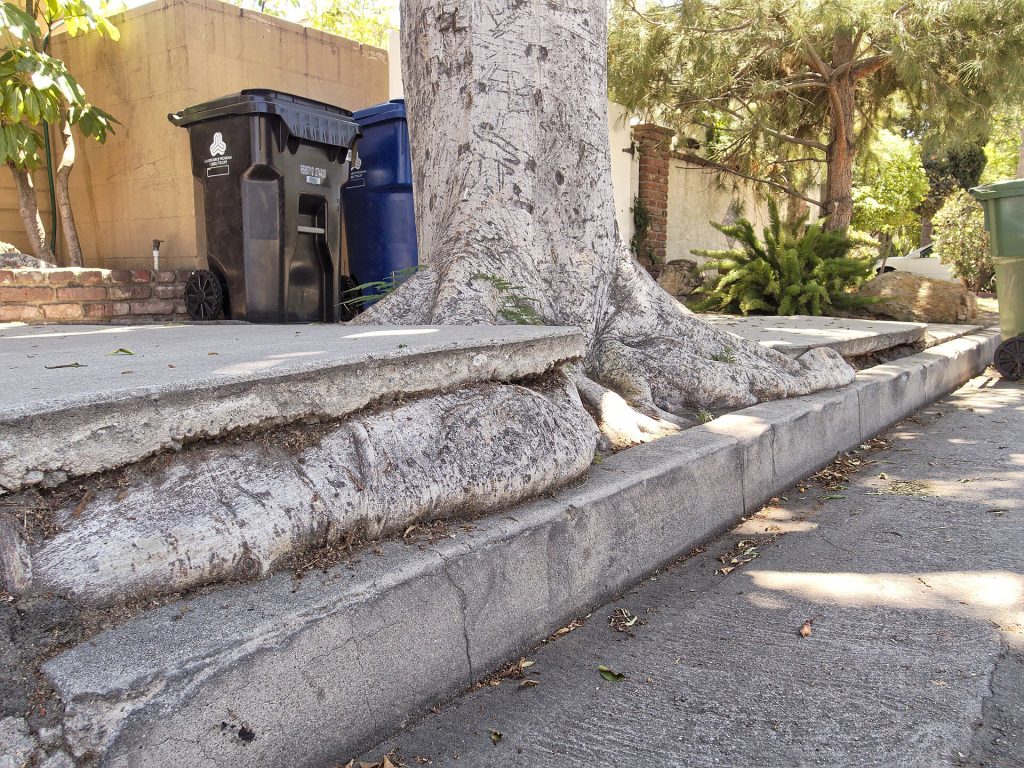
Most of a mature tree’s roots sit in the top 15 to 60 cm of soil, and they spread outward well past the branch tips — two to five times the width of the crown. Nothing about a big tree is buried deep. The part that holds it up and feeds it is in the same shallow layer a trencher, a mini-excavator or a load of fill goes straight through.
So when a contractor quotes you for a new driveway, a patio, a fence line or a buried service, the tree beside it is part of that job whether anyone says so or not. Here is what gets cut, how much a tree can lose before it is finished, and what to settle before the machine shows up.
The roots are not where most people picture them
The picture in everyone’s head is a mirror image of the tree: a deep taproot, roots stopping where the branches stop. Neither is true. Colorado State University Extension’s fact sheet on tree roots (2.926, reviewed August 2025) puts it plainly: “Most tree roots are in the top 6 to 24 inches of the soil” — roughly 15 to 60 cm — and the root system “extends outward past the dripline, two to five times the diameter of the average tree’s crown.” Its construction fact sheet (7.420, reviewed August 2025) gives a blunter version: the root zone reaches out from the trunk “at least equal to the tree’s height.”
Against a real yard: a 20-metre silver maple in a front lawn has roots under the driveway, under the walkway and out under the road. There is no version of replacing that driveway that does not involve the tree.
What a trench across the front lawn actually cuts
A trench is the worst of the common jobs, because it is a clean cut through everything in its path at exactly the depth the roots live at. A 60 cm trench for a water line, a downspout run or a conduit does not pass under the root system. It passes through it.
Distance from the trunk decides how bad it is: roots branch as they go out, so a cut near the trunk severs a few large roots that each supply a wide fan of the system.
- A trench on one side only takes that side’s anchorage with it — a stability question, not just a health one. See telling a settled lean from a failing one →
- A cut root is an open wound below ground, and decay organisms use it. Fungal fruiting at the base years later often traces back to one — see our guide to mushrooms at the base of a tree →
- Boring under the roots is the fix, and it exists. Both CSU fact sheets say it: where a trench must pass near a tree, auger a tunnel beneath the roots rather than cut through them. It costs more per metre and far less than the tree.
Two rules of thumb, and they do not agree
There are two widely used numbers for how much ground a tree needs left alone. It is more useful to know both than to pretend there is one.
- One foot of radius per inch of trunk diameter. CSU 7.420: “for each 1 inch of trunk diameter, extend the protection area an additional 1 ft.”
- One and a half feet per inch. Purdue Extension’s Construction and Trees: Guidelines for Protection (FNR-463-W, March 2012) multiplies trunk diameter in inches by 1.5 for the protected root zone radius in feet.
On a trunk 40 cm across — about 16 inches — that is a protected circle of roughly 5 metres radius by the first rule, 7.3 metres by the second. Both are bigger than the gap most people leave.
They disagree on damage thresholds too. CSU 7.420: “decline and death can result if more than 40 percent of the stem or roots are damaged or killed.” Purdue is tighter: “do not allow more than 25 percent of the roots in the PRZ to be damaged.” We work to the tighter one. If a job is close enough that the difference between 25 and 40 per cent decides it, the job is too close.
The damage nobody photographs
Cut roots leave a mark. Two other things do not.
Compaction. CSU 2.926 calls it “one of the biggest killers of urban trees” because it “restricts water and oxygen uptake by roots.” Roots need air in the soil. Driving a loaded truck or a skid steer across the root zone squeezes that air out, and the ground does not spring back. Ottawa clay compacts readily and stays compacted — and after the wettest summer in the city’s recorded history, a lot of ground went into this autumn already saturated, which is when soil compacts worst.
Raising the grade. Adding soil over roots looks like the gentlest thing you could do. CSU 2.926 is specific: “only 4 to 6 inches of soil over an existing root system drastically reduces the amount of oxygen and water available to the roots.” That is 10 to 15 cm — less than most people add to level a yard before sod. If the grade must come up near a mature tree, settle that before the fill is ordered.
Why the tree looks fine for three years
This is the part that costs people money: by the time the tree tells you, the contractor is long gone and nobody connects the two events. Both sources say it independently. CSU 7.420: “trees may be slow to respond to stress and decline and dieback may gradually appear over a period of years.” Purdue: “trees damaged during construction projects may take years to exhibit symptoms.”
A mature tree carries reserves and spends them holding the line, and the crown looks normal while it does. What you eventually see is thinner leaf cover, smaller leaves, dieback at the top and outer tips, and shoots pushing from the trunk lower down. If a tree started doing that two or three summers after work near its base, the work is the first thing to look at.
What we would not do
- We would not fertilise a root-damaged tree to “help it recover.” Pushing top growth onto a system that just lost a chunk of its roots puts more crown on less support. Water it in dry spells and leave it alone.
- We would not cut the crown back to “balance” the root loss. It sounds logical and gets sold often. The tree needs its leaves to rebuild roots, and heavy pruning removes the thing doing the repair. Reducing genuine wind load on a tree that has lost anchorage on one side is a narrower, different job — that is what crown and sail reduction → is for.
- We would not accept “we’ll be careful around the tree” as a plan. Careful is not a distance. A fenced exclusion zone is.
What to settle before anyone digs
- Get the locates in. Anyone digging in Ontario — homeowner, renter or contractor — must submit a locate request to Ontario One Call first, under the Ontario Underground Infrastructure Notification System Act, 2012. Owners have five business days to complete a standard locate. Build it into the schedule.
- Mark the protection zone on the ground with paint or fencing before the machines arrive. A line on a lawn is understood; a sentence in a quote is not.
- Ask where the trench runs, how deep, and whether it can be bored under the roots instead. Ask before you sign, while it is still a price and not a change order.
- Decide honestly whether the tree is staying. Sometimes the driveway matters more, and that is a legitimate answer — far better made deliberately now than discovered by accident in 2029. A removal is also cheaper and safer before new hardscape sits in the drop zone.
If you want eyes on it
If you have a project coming up near a mature tree, or a tree that has declined since work was done near it, we will come and look. Quotes are free. Photos help — the whole tree, the base, and where the work is planned is usually enough to say whether a visit is worth making.
Max is Tree Risk Assessment Qualified (TRAQ) and does every quote himself, so the person telling you what the tree can take is the one who would do the work. Our minimum charge on any job is $160 + HST, covering everything. For anything urgent — a tree that has moved, or ground that has lifted since a project — call (613) 715-0103.
Get a free quote → · Pruning and crown reduction → · Tree removal →
Quick answers
How close to a tree can you dig without killing it?
There is no single safe distance. The two common rules are one foot of radius for every inch of trunk diameter, or one and a half feet per inch — on a 40 cm trunk, roughly 5 to 7.3 metres out. Closer than that, damage rises quickly, because roots near the trunk are large ones that each supply a wide section of the tree.
How much of a tree’s roots can be cut before it dies?
The published thresholds differ. Colorado State University Extension says decline and death can result once more than 40 per cent of the stem or roots is damaged; Purdue Extension advises not letting more than 25 per cent of roots in the protected zone be damaged. We plan to the tighter figure, because neither accounts for a tree that was already stressed.
My tree started dying two years after we redid the driveway. Is that related?
It can easily be. Both Colorado State and Purdue Extension note that trees damaged during construction may take years to show symptoms, because a mature tree spends stored reserves holding its crown together first. Thinning foliage, dieback at the top and outer tips, and shoots from the lower trunk are the usual signs.
Do I need locates before digging near a tree in Ottawa?
Yes, and it is not optional. Anyone who digs in Ontario must submit a locate request to Ontario One Call first, under the Ontario Underground Infrastructure Notification System Act, 2012. Infrastructure owners have five business days to complete a standard locate, so it belongs in the schedule.
Photo: tree roots and buttress lifting a concrete sidewalk and curb, San Fernando Valley, California, 2 May 2015, by Junkyardsparkle — Wikimedia Commons, CC0 1.0. Illustrative — it shows how much structural root sits directly beneath a hard surface. Sources: Colorado State University Extension fact sheet 2.926 (root depth and spread, compaction, grade change; reviewed August 2025); CSU Extension fact sheet 7.420 (protection radius, 40 per cent threshold, boring under roots, delayed decline; reviewed August 2025); Lindsey Purcell, Purdue Extension FNR-463-W, March 2012 (protected root zone formula, 25 per cent threshold, delayed symptoms); Ontario One Call (locate obligations and the five-business-day requirement); CTV News Ottawa, 12 Aug 2026 (wettest summer on record).
Max Trees publishes its prices: see the full 2026 price schedule for Ottawa tree removal, pruning and stump grinding.