
Canada surveyed 1,739 sites for the Asian longhorned beetle last year and did not find it at a single one. Oak wilt: 129 sites across six provinces, no detections anywhere. Hemlock woolly adelgid turned up in Ontario at eight sites — all of them in Scarborough or Norfolk County, none of them near here.
Those numbers come from the Canadian Food Inspection Agency’s plant health survey report for 2025–26. If somebody has told you your oak needs protecting, or that there is a beetle coming for your maple, this is the page that tells you what is actually in the ground around Ottawa and what is not. One of these pests is here. It is already everywhere, and it is not the one people phone us about.
Where these numbers come from
The CFIA runs annual surveys for the pests that could do real damage if they established here. Inspectors put out traps, walk sites and check host trees, and the agency publishes what was looked at and what was found. The 2025–26 report covers samples collected between 1 April 2025 and 31 March 2026, and the page was last updated 6 August 2026.
The reason we would rather send you to that than to a news story is that it tells you the sample size. “Not detected” means nothing on its own. “Not detected at 1,739 sites” means something. It also tells you the year, which matters more than it sounds like it should — a lot of the pest advice floating around this month was written for a different year and, half the time, a different province.
One honest caveat before the rest of this. A survey that finds nothing is not a guarantee. It means the pest was not found at the places that were checked, in that window. It can still arrive next year, usually in somebody’s firewood.
Asian longhorned beetle: 1,739 sites, not one beetle
This is the one with the pictures that get shared — the big black-and-white beetle that chews through maple, birch, willow and poplar. It was found in Canada for the first time in September 2003, an eradication programme was run, and in 2020 it was declared eradicated from the country on the strength of five years of negative survey data.
It has stayed that way. In 2025 the CFIA surveyed 1,739 sites across every province and found it at none of them. The report’s own summary line is short: “Canada is considered free from the Asian longhorned beetle.”
The surveys keep running because the beetle keeps arriving in wood packaging from overseas, and because the last eradication was expensive. That is a good reason for the CFIA to spend money. It is not a reason for you to spend any. If someone offers you a treatment for this beetle on a maple in Barrhaven, you are being sold something that protects against a pest that is not in the country.
Oak wilt: nothing new since 2023
Oak wilt is a fungus that can kill a red oak in a single season, and it was found in Canada for the first time in 2023, at three locations in Ontario. That detection is real and it is why the rules around oak pruning changed. What has happened since is less dramatic than the headlines suggest.
In 2025 the CFIA surveyed 57 sites in Ontario and recorded no new detections. Across the country it was 129 sites and none. The agency also assessed more than 104 public reports of suspected oak wilt and followed up with site visits where it made sense, and ran delimitation surveys around the three 2023 sites. Nothing. Ontario’s own forest health conditions report, last updated 13 May 2026 and covering 2025, says the same thing: no new occurrences.
The pruning window still stands, and we still work to it. Not because oak wilt is at your door, but because the cost of getting it wrong is a dead oak and the cost of getting it right is waiting until winter. We wrote out the whole calendar in when to prune trees in Ottawa.
Hemlock woolly adelgid and spongy moth: real, and not here
Hemlock woolly adelgid kills eastern hemlock and it is genuinely established in parts of this province. In 2025 the CFIA surveyed 78 sites in Ontario and found it at eight: two in Scarborough and six in Norfolk County. Both are southern Ontario. If you have hemlock in the yard here, it is worth knowing the name and worth a look at the undersides of the needles for the white woolly specks — but nothing in the current survey data puts it in this part of the province.
Spongy moth is the other one people still ask about, because the defoliation years of 2020 and 2021 left an impression. Ontario’s forest health report for 2025 mapped no spongy moth defoliation at all. The population crashed and has not come back. Scraping egg masses off your trunks this autumn is a lot of work aimed at a caterpillar that is not currently eating anything around here.
The one that is here is the one nobody phones about
Ontario’s emerald ash borer line in the same report reads “no detections outside the regulated area” across 80 sites. That sounds like good news until you read what the regulated area is. The CFIA’s regulated areas list, updated 12 August 2026, names Ottawa outright — along with Lanark, Renfrew, Leeds and Grenville, Prescott and Russell, and Stormont, Dundas and Glengarry.
So the survey result is not “Ottawa is clear.” It is “it did not spread to new ground.” We are the old ground. Every ash in this city is either dead, dying, being treated, or on a clock.
Here is the part worth sitting with. In the same report, the CFIA logged 106 public inquiries about oak wilt, which has never been detected outside those three 2023 sites, and 53 about emerald ash borer, which is established across this entire region and is killing trees in this city right now. Twice as many people are worried about the one that is not here. If you have an ash, start with how to tell if your ash is done.
What we would not do
- We would not pay for preventive treatment against a pest that is not in the country. Injections and soil drenches aimed at Asian longhorned beetle, on current survey data, buy you nothing.
- We would not treat a healthy oak for oak wilt in Ottawa. There is no confirmed oak wilt within hundreds of kilometres of here and no detection anywhere in Canada in 2025. Prune it in the right window instead. That is free.
- We would not take a tree down on a pest rumour. If you are told your tree has something, ask what it is called, then look up whether that thing has ever been found in this province. Most of the time the answer settles it in a minute.
- We would not move firewood. This is the one thing on the list that actually matters and it costs nothing. The CFIA’s own oak wilt survey targets campgrounds specifically because oak firewood gets carried in from infested areas. Buy it where you burn it.
- We would not read “not detected” as “cannot arrive.” These surveys exist because it can. They are a snapshot, not a promise.
If you want eyes on it
If something on your tree is bothering you, send us a photo — the whole tree from a distance, then the part that looks wrong. Most of what gets reported to us as a pest turns out to be a fungus, a mechanical injury or a root problem, and you can usually tell from two pictures whether it is worth a visit.
Quotes are free and Max does every one himself. He is Tree Risk Assessment Qualified (TRAQ), which is the credential that covers reading a tree for failure risk. Our minimum charge is $160 + HST and it covers everything — there is no separate call-out fee on top. For anything urgent, call (613) 715-0103.
Get a quote · Tree removal · Pruning
Quick answers
Is oak wilt in Ottawa?
There is no record of it here. Oak wilt was found in Canada for the first time in 2023, at three locations in Ontario, and the CFIA recorded no new detections anywhere in the country in 2025 across 129 surveyed sites. Ontario’s own forest health report for 2025 says the same. It is worth taking seriously as a future risk, not as a present one.
Should I have my oak treated to prevent oak wilt?
We would not. There is no confirmed oak wilt in eastern Ontario and none was detected anywhere in Canada in 2025. The useful protection is free: do not prune or wound an oak during the growing season, and do not bring in oak firewood from outside the area. Save the money for work the tree actually needs.
Is the Asian longhorned beetle in Canada?
Not according to the most recent federal survey. It was declared eradicated from Canada in 2020 after five years of negative survey results, and the CFIA checked 1,739 sites in 2025 without finding it. The agency’s current position is that Canada is considered free from the beetle. Surveys continue because it keeps arriving in imported wood packaging.
Which tree pest should an Ottawa homeowner actually worry about?
Emerald ash borer, and only if you own an ash. Ottawa sits inside the CFIA’s regulated area for it, which means it is long established here rather than newly arriving. Everything else on the alert lists is either not in this province or not in this country. If you have an ash you have a decision to make; if you do not, you mostly do not.
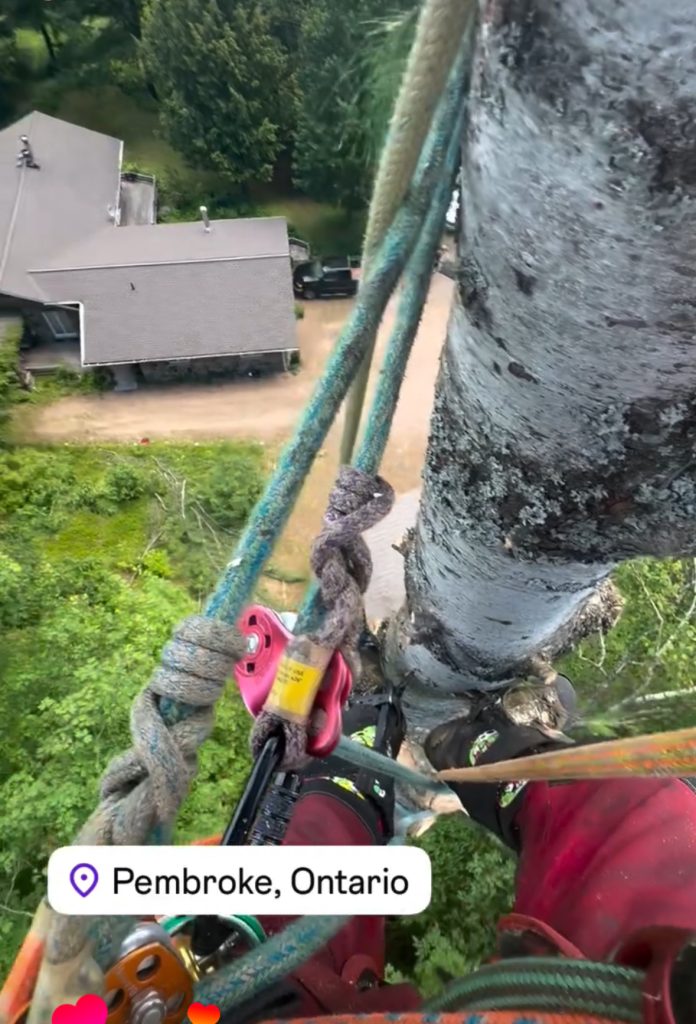
Photo: Max Trees — a climber rigging a lowering line on a removal in the Ottawa Valley. Sources: Canadian Food Inspection Agency, Plant health survey report for 2025–2026 (samples collected 1 April 2025 – 31 March 2026; page last modified 6 August 2026) for all survey site counts, detections and public-inquiry figures; CFIA directive D-03-08, Regulated areas and items: emerald ash borer (last modified 12 August 2026) for the regulated-area list naming Ottawa; Government of Ontario, Forest health conditions (last updated 13 May 2026, reporting 2025 conditions) for oak wilt and spongy moth. Written 18 September 2026 — survey results are published annually, so check the current report before acting on a figure here.
Have a dead or dying ash? See dead ash tree removal in Ottawa: $500 to $2,500 while the tree can still be climbed, a bucket or crane at cost after two or three winters standing dead, no City permit for a dead or borer-infested ash (photograph it first), and why the wood cannot leave the Ottawa–Gatineau regulated area.
Taking wood to the cottage this fall? Read what the federal firewood rule actually says for Ottawa: moving ash firewood out of the CFIA’s emerald ash borer regulated area is prohibited all year, cottage trips included; non-ash firewood can only leave the area through a CFIA-approved facility, so a private household has no legal route out with any species; yard waste is under the same rule; but most of eastern and central Ontario (Renfrew, Lanark, Frontenac, Leeds and Grenville, the Kawarthas, Muskoka) is inside the same regulated area as Ottawa, so most cottage trips never cross the line.
Heard the spotted lanternfly has reached Ontario? Read what the federal record actually says about Ottawa: the first live detection in Canada was Windsor on 15 September 2026; Ottawa’s only entry is one dead insect intercepted in January 2023; significant damage has only been observed on grapes, not maples; and September–October is when egg masses (grey putty, later cracked mud) get laid on trunks, vehicles and patio furniture.
Related: how to tell if your ash has emerald ash borer (the one pest that is here) · the Ottawa tree care calendar for the oak (April–November) and elm (April 1–September 30) no-pruning windows · our published prices if a dead ash does have to come out.
Max Trees publishes its prices: see the full 2026 price schedule for Ottawa tree removal, pruning and stump grinding.
Update, 26 October 2026: the CFIA now lists the spotted lanternfly as established in Essex County, with a regulated area covering Essex, Windsor, Pelee and Chatham-Kent. Anything leaving that area — nursery stock, outdoor household items, ornamental stone, firewood — must be free of every life stage of the insect first. Ottawa’s record is unchanged: one dead insect intercepted in January 2023, never a live one.