
Ash firewood is not allowed to leave the Ottawa area — but the cottage you are driving to this weekend is probably inside the same regulated area, so that trip is almost certainly legal. Both of those facts come out of the same federal directive, and almost nobody repeating “never move firewood” can tell you which one applies to their own drive.
Firewood season is on. So here is what the Canadian Food Inspection Agency actually prohibits, where the line falls when you leave Ottawa with a load of wood, and what you can do with the ash you just had taken down. We are not lawyers and this is not legal advice — it is a plain reading of a published directive, with the links so you can check it yourself.
Ottawa is inside the regulated area, and everything else hangs off that
The CFIA runs a national regulated area for emerald ash borer, and Ottawa is named in it. So is nearly everything around us. From the agency’s own list of regulated areas, last modified 12 August 2026, the eastern and central Ontario entries include:
- Ottawa — the whole city, urban and rural
- The counties of Lanark, Renfrew, Frontenac, Hastings, Lennox and Addington, Haliburton, Northumberland and Peterborough
- The United Counties of Leeds and Grenville, Prescott and Russell, and Stormont, Dundas and Glengarry
- Kawartha Lakes and Prince Edward
- The districts of Muskoka, Nipissing, Parry Sound and Timiskaming
That list is the whole game. Every rule below is written as a restriction on moving wood out of the regulated area. If your start point and your end point are both inside it, this prohibition is not the thing standing in your way.
Ash firewood cannot leave, and the CFIA names your cottage trip specifically
This is the clearest sentence in the whole programme and it is worth quoting: “Moving ash firewood out of a regulated area is prohibited, whether for commercial or private purposes (such as taking firewood to the cottage or camping).”
Ash is not only firewood, either. The regulated list covers ash trees whole or in parts, nursery stock, logs and branches, lumber, bark, and wood or bark chips. Moving any of it out of a regulated area needs a movement certificate issued by the CFIA. And if the beetle is confirmed on a specific property, a Movement Prohibition Notice stops affected material leaving that address at all.
The rule is blunt because the beetle is bad at travelling on its own. It gets the distance from us, in wood people put in a vehicle. That is how it spread from its 2002 discovery in Windsor to here. If you want the tree-level side of it, that is covered in our guide to telling whether your ash is done.
Non-ash firewood is not the free pass people think it is
Most people who know the ash rule assume the workaround is to burn maple or birch instead. Read the directive again: “Domestic movement of non-ash firewood out of a regulated area is only permitted by facilities approved under the program.”
Facilities. Not people. There is no homeowner version of that permission — no form to fill in, no allowance for a few pieces in the back of a pickup. In practice, if you are a private individual, no species of firewood has a legal route out of the regulated area. The ash rule is the one everybody quotes. The non-ash rule is the one that catches people out.
It is not only about ash borer either. The directive says non-ash movement is also subject to restrictions under other CFIA policies, and there are now separate movement restrictions around Windsor following the first Canadian spotted lanternfly detection this month.
Where the line actually falls when you drive out of Ottawa
Here is the honest shape of it. Almost every direction an Ottawa household drives for a long weekend — the Valley, Lanark, the Thousand Islands, Kingston, the Kawarthas, Muskoka, Algonquin — finishes inside the regulated area. Same regulated area at both ends. The directive even carries a separate appendix for moving regulated material from one regulated area to another.
Where it stops being inside is further out: northern Ontario beyond the districts and townships on the list, and anywhere the CFIA has simply not named. Two things worth doing with that:
- Do not assume a boundary you already know is the boundary. The regulated area is not the province, not the city limit, not the watershed. It is a specific written list of counties, districts and municipalities.
- Look up the actual destination. It is one CFIA page and it takes a minute.
Your leaves and branches are under the same rule
This is the part that surprises people in October. From the same page: “Movement of yard waste outside of regulated areas is also prohibited, as it may contain ash tree bark, branches or trimmings.”
So the trailer of brush you were going to run out to a relative’s place in the country and burn is covered too, if that place sits outside the regulated area. The CFIA’s own instruction for regulated yard waste is to contact your municipality, because municipalities inside infested areas often set up their own handling procedures. For anything we take down, the wood and the brush stay inside the regulated area.
The 1 October change that does not mean what people think
The directive splits the year in two. 1 April to 30 September is the high-risk period, when the beetle is emerging and flying. 1 October to 31 March is the low-risk period. Those dates sit in the current sixth revision of the directive, effective 1 April 2026.
What changes on 1 October is what a certificate holder may move and under what conditions — ash logs, for instance, can be shipped under certificate to an approved facility in the low-risk season and not in the high-risk one. What does not change is anything about your woodpile. The prohibition on taking ash firewood out of the regulated area runs all year. Nobody gets a winter window on it, and wood being frozen, split or seasoned does not move it outside the rule.
What we would not do
- We would not take wood to the cottage even where it is legal. Legal and sensible are two questions. Ash borer is not the only thing that rides in a log, and the entire point of buying wood where you burn it is that nothing gets the lift.
- We would not buy a cheap truckload from someone who cannot say where it was cut. Wood that arrived from a long way off, sold below everyone else, is the likeliest way something new turns up on your street.
- We would not treat “it is seasoned” as clearance. Insects and fungi live in dry wood and under dry bark. Seasoning is about how it burns, not about what is inside it.
- We would not move ash off a property under a Movement Prohibition Notice for any reason, including a neighbour asking for a few rounds.
- We would not read a park’s firewood policy as the federal rule. A campground can tell you to buy its wood and leave your leftovers behind on a trip where the directive does not apply at all.
If you want eyes on it
If you have an ash on the property and you are working out whether it is still worth keeping, send photos — one of the trunk, one of the whole tree from a distance — and we will tell you honestly what stage it is at, including if the answer is to leave it alone. Quotes are free. For anything that looks unsafe right now, call (613) 715-0103 rather than sending an email.
Wood off a job here is either left stacked on site for you or hauled away and disposed of inside the regulated area. Ash from your own property can be burned on your own property. If you want the wider picture on which pests are actually here and which ones you are only being warned about, we went through the survey evidence in this guide.
Get a quote → · How removal works → · Stump grinding →
Quick answers
Can I take firewood from Ottawa to my cottage?
If the cottage is inside the CFIA’s emerald ash borer regulated area, the prohibition on moving wood out of that area does not apply to the trip. Most of eastern and central Ontario is inside it, including Renfrew, Lanark, Frontenac, Leeds and Grenville, the Kawarthas and Muskoka. If the destination is outside it, you cannot take ash firewood at all, and non-ash firewood can only be moved out by a facility approved under the CFIA programme. Check your destination against the CFIA list rather than guessing.
Is it illegal to bring firewood home from the cottage?
Same test, run backwards. What matters is whether the wood is leaving a regulated area, not which direction you are driving. Carrying ash firewood from a regulated area back into Ottawa is movement inside the regulated area. Bringing wood home from somewhere outside the regulated area is not restricted by this directive, although other directives can apply. Either way, the sensible answer is to burn it where you bought it and leave the leftovers behind.
How do I tell whether my destination is in the regulated area?
The CFIA publishes one page listing every regulated area by county, district and municipality, and it carries a date so you can see how current it is — the version behind this guide was last modified 12 August 2026. Read the entry for your destination rather than assuming, because the boundary does not follow the province, the city limit, or any line you would recognise from a road map.
Can I burn ash firewood from my own property in Ottawa?
Yes. Ash from your property can be used on your property, and because Ottawa sits inside the regulated area, nothing is leaving it. What you cannot do is move it out of the regulated area. If the CFIA has issued a Movement Prohibition Notice for your address, affected material cannot leave that property at all. Municipal open-air burning rules are a separate matter from the federal directive, so check those too.
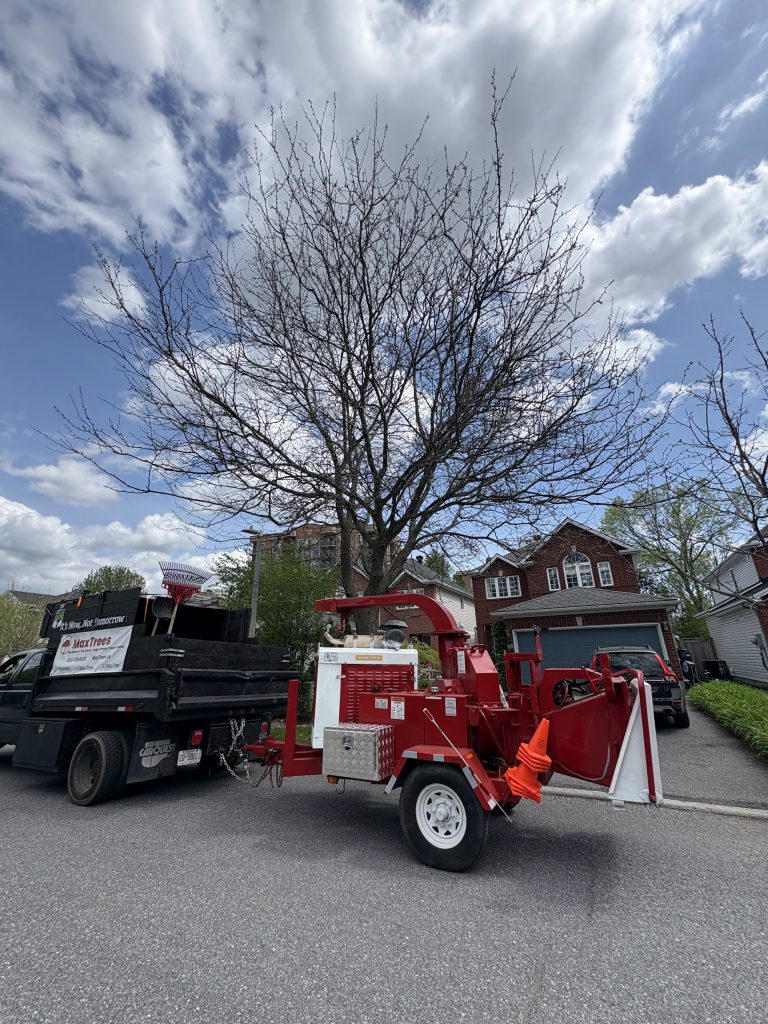
Photo: Max Trees, Ottawa — wood loaded out from a residential removal. Sources: Canadian Food Inspection Agency, Regulated areas and items: Emerald ash borer, last modified 12 August 2026; and CFIA, D-03-08: phytosanitary requirements to prevent the introduction into and spread within Canada of the emerald ash borer, sixth revision, effective 1 April 2026. Both pages read 28 September 2026. This is a plain reading of a published federal directive and not legal advice.
Related: how to tell if your ash has emerald ash borer (D-shaped exit holes, blonding, crown dieback) · what a dead ash costs to remove in Ottawa and why the quote goes up every winter it stands · which tree pests are actually in Ottawa (the federal survey numbers) · the spotted lanternfly and the Windsor movement restrictions · our published prices if the ash has to come out.
Max Trees publishes its prices: see the full 2026 price schedule for Ottawa tree removal, pruning and stump grinding.
Update, 26 October 2026: the CFIA now lists the spotted lanternfly as established in Essex County, with a regulated area covering Essex, Windsor, Pelee and Chatham-Kent. Anything leaving that area — nursery stock, outdoor household items, ornamental stone, firewood — must be free of every life stage of the insect first. Ottawa’s record is unchanged: one dead insect intercepted in January 2023, never a live one.