
On 23 October 2026 the Canadian Food Inspection Agency confirmed an established spotted lanternfly population in Canada for the first time, and put a regulated area in place covering Essex County, the city of Windsor, the township of Pelee and the municipality of Chatham-Kent. That is the far southwestern corner of the province. Ottawa is not in the regulated area, and the federal record for this city did not change.
We wrote about this insect five weeks ago and said it was not established anywhere in Canada. That was true when we wrote it and it is not true now. So here is what actually moved, what did not, and the one new rule that reaches a homeowner in Ottawa.
What changed on 23 October
Two things, and they are connected.
- The status went up a category. The CFIA had been calling Windsor a detection — a live insect confirmed in the Canadian environment by an official survey. It now reads: “Following the initial detection in Windsor, hundreds of confirmed spotted lanternfly observations were received across Essex County and we now consider there to be an established population of SLF in this area.” Established means a breeding population, confirmed by survey. That is the top of the agency’s four-step scale.
- A regulated area now exists. Essex County, Windsor, Pelee and Chatham-Kent. The CFIA says surveillance outside that area is continuing.
Chatham-Kent is worth noticing. It is in the regulated area as an area next to an established population, not because a population was confirmed there. That is the agency drawing a buffer, which is what the response framework tells it to do.
Ottawa’s line in the table did not move
We read the observation table rather than the headlines, and we read it again this morning. Ottawa still appears exactly once: January 2023, an interception, dead. An interception is a specimen the CFIA confirmed but did not find on a survey — something that arrived on a vehicle. There has still never been a live spotted lanternfly recorded in this city.
What did move in the table is Niagara. Fort Erie has a live sighting in October 2026, and Port Colborne one in September 2026. Those are reports the agency logged and followed up, not survey detections, and they are still three hundred-odd kilometres southwest of here. But they are the second cluster to watch, and they sit on the busiest truck corridor into the province.
One housekeeping note, because it matters if you go looking yourself: Essex County observations are no longer listed one by one in that table. The CFIA now covers them with the single established-population entry. So the table getting shorter in that column does not mean the problem got smaller.
The new rule that actually reaches Ottawa
This is the practical part, and it is the only part of the 23 October announcement that changes what an Ottawa household should do.
Anything moving out of that regulated area into the rest of the country has to be free of every life stage of this insect before it moves. The CFIA names nursery stock, outdoor household items, ornamental stones and firewood, and says plainly that the list is not limited to those four.
So if you are buying or hauling from Windsor-Essex or Chatham-Kent this autumn — a trailer of stone, plants from a grower down there, a load of wood, patio furniture out of a family member’s yard — the obligation to check is now yours before it travels. Egg masses are laid on hard surfaces, not just on bark, which is why stone and furniture are on that list at all.
And firewood, again. We have written this about ash borer and again about moving wood out of Ottawa, and it keeps being the same sentence: buy it where you burn it.
What it does to a tree, and what it still does not do
Nothing in the 23 October update changed the damage picture, and this is the part most coverage gets wrong.
It is a sap feeder. The CFIA’s wording has not moved: it can feed on more than 100 species of trees and plants, “however, significant impacts from this feeding have only been observed on grapes.” For vineyards and growers this is a serious event. For the maple on your front lawn, on the evidence that exists today, it is not the same kind of problem.
The comparison people reach for is emerald ash borer, and it is the wrong one. Ash borer kills the tree, reliably, and it is already everywhere here. Neither CFIA page says this insect kills trees. What a homeowner in an infested area notices is mess — sticky honeydew, sooty mould, wasps round the trunk — rather than a dying tree.
Our earlier guide has the full identification detail: what the adults, nymphs and egg masses look like, and how to tell this insect from the native ones it gets confused with. We are not going to retype it here.
Between now and spring, the thing to look at is egg masses
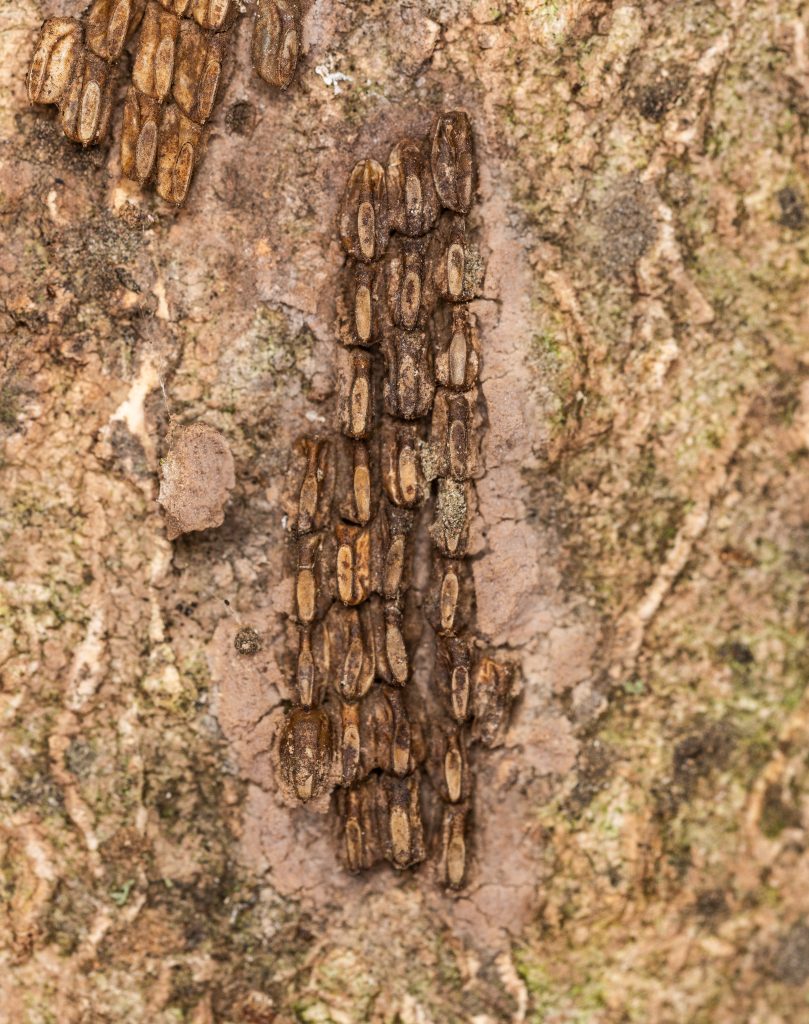
Autumn is when the adults lay, and the eggs are what overwinters. They go on tree trunks, but also on brick, stone, fences, grills, trailers, equipment and vehicles — anything flat that sits outside.
That makes the Ottawa job small and specific, and it is a looking job, not a treating job. If something came back here from the regulated area, from Niagara, or from Pennsylvania or New York State, look it over before it goes into the garage or the shed for winter. The CFIA states the eggs can survive winter temperatures and hatch in spring, so the assumption that our cold handles this for us is not supported.
We got overtaken, and that is worth saying out loud
On 25 September we published that the CFIA had not confirmed an established population anywhere in Canada. We quoted the agency’s own page saying it. Five weeks later the agency changed its position.
We are flagging that rather than quietly editing it, because a tree company that only ever reports the news that flatters it is not worth reading. The earlier post was accurate on its date and is now behind the record. This one is accurate on 26 October 2026, and it will go the same way if the picture moves again. Check the CFIA pages before you act on anything here, including this.
What we would not do
- We would not spray. There is no live spotted lanternfly on record in Ottawa. A preventative insecticide programme for an insect that is not here costs money and kills the insects that are.
- We would not band or trap a tree. Same reason. There is nothing here to catch, and a sticky band wrapped round a trunk catches birds and squirrels.
- We would not take a tree down over this. Not on a federal record that says significant impacts have only been observed on grapes, and not with no live record in eastern Ontario.
- We would not stomp a spotted bug here. The CFIA tells people inside the regulated area to kill them on sight. Ottawa is not inside it, and outside it the agency wants the specimen: photograph it, catch it or scrape the egg mass into a sealable container, and report it. Destroying the evidence of a first local record is the opposite of helpful.
- We would not panic about a tree in your yard. If a tree worries you, the reason is almost certainly something else — and most of the pests Ottawa gets warned about are still not here.
If you want eyes on it
Report a suspected spotted lanternfly to the CFIA, not to us — going straight to them is faster and they want the specimen.
But if something on a tree worries you and you cannot tell what it is, we will look. Quotes are free, and photos are usually enough to start: one shot of the whole tree, one close-up of the problem. If a limb or a tree looks like it is about to come down, do not wait on email — call (613) 715-0103.
Get a quote · Tree removal · Pruning
Quick answers
Is the spotted lanternfly in Ottawa?
Not on the federal record. The CFIA observation table lists Ottawa once — January 2023, a dead insect intercepted, not found on a survey. There has never been a live record here. The established population confirmed on 23 October 2026 is in Essex County, at the far southwestern end of the province.
Where is the spotted lanternfly regulated area in Ontario?
Essex County, the city of Windsor, the township of Pelee and the municipality of Chatham-Kent. The CFIA put it in place on 23 October 2026 after confirming an established population in Essex County. Ottawa is not in it, and surveillance outside the area is continuing.
Can I bring firewood or plants back from Windsor-Essex?
Only if they are free of every life stage of the insect. The CFIA requires anything moving out of the regulated area to be checked first, and names nursery stock, outdoor household items, ornamental stones and firewood among the things it applies to. With firewood the simpler answer is the old one: buy it where you burn it.
Will the spotted lanternfly kill my maple tree?
There is no evidence that it will. The CFIA says it feeds on more than 100 species of trees and plants but that significant impacts from that feeding have only been observed on grapes. Neither of its spotted lanternfly pages says the insect kills trees. What people in infested areas notice is honeydew, sooty mould and wasps rather than a dying tree.
Photo: spotted lanternfly egg mass, Pennsylvania, 16 July 2018 — Stephen Ausmus, USDA Agricultural Research Service. Public domain, via Wikimedia Commons. Sources: Canadian Food Inspection Agency, news release of 23 October 2026 for the regulated area and the movement requirement; Spotted lanternfly (date modified 23 October 2026) for the established-population wording, the host range, the grapes-only impact statement and the reporting instructions; and Spotted lanternfly observations in Canada (date modified 13 October 2026) for the observation table, the Ottawa entry, the Niagara entries and the four observation categories. Written 26 October 2026 — this is a live and changing situation, so check the CFIA pages for the current position before acting on anything here.
Max Trees publishes its prices: see the full 2026 price schedule for Ottawa tree removal, pruning and stump grinding.
Related: our 25 September guide with the full identification detail (adults, nymphs, egg masses, and the native insects it gets confused with) · which tree pests are actually in Ottawa and which are not · moving firewood from Ottawa, the ash-borer rule that already applies to every load here · the Ottawa tree care calendar · our published prices if a tree has to come out for another reason.