
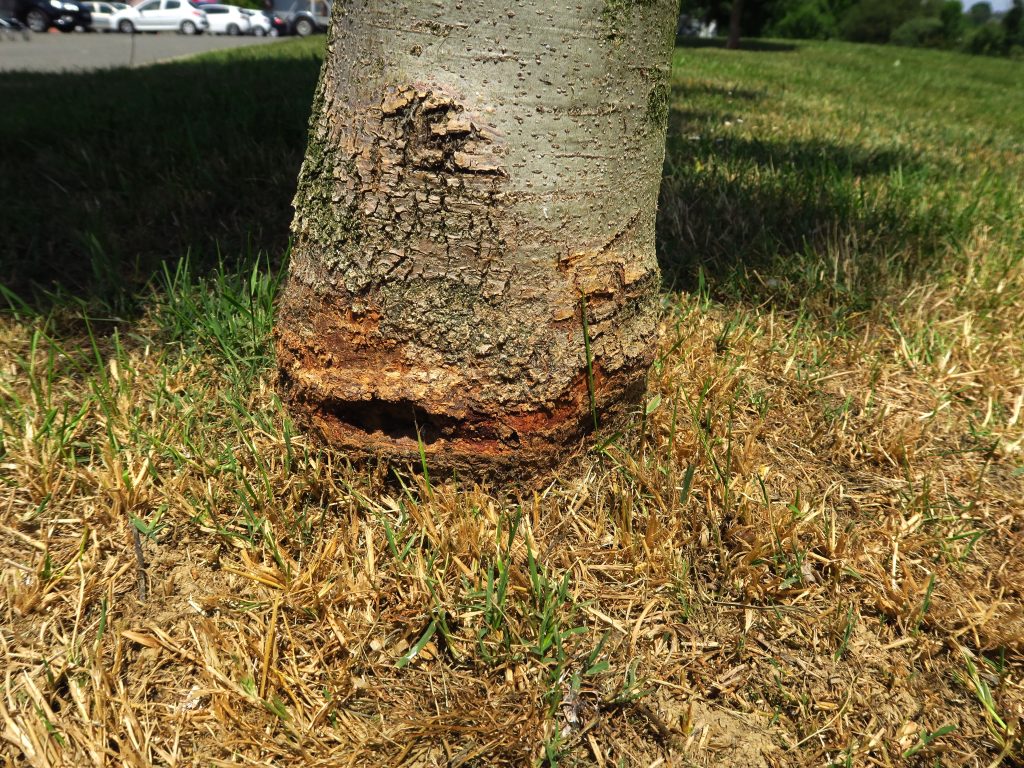
On a young maple or birch, the bark protecting the tree’s entire water and food supply can be less than 1/16 of an inch thick — about 1.5 mm. A string trimmer takes that off in one pass. The tree will look completely normal for another three or four years.
Mowing season is about done in Ottawa. The grass has stopped growing, the leaves are coming off, and for the next few weeks you can actually see the bottom of your own trees. This is what to look for, and what it means if you find it.
It happens at the root flare, and that is not bad luck
The injury is almost always in the same place. Purdue Extension’s forestry blog, in a post dated 24 April 2026, puts it plainly: the site of injury is usually the root flare — where the tree meets the turf and gets in the path of the mower or trimmer.
That is the geometry of the job, not carelessness. Grass grows right up to the trunk, so a machine has to go there. A mower deck nudges the bark going past. A trimmer head whips a nylon line into it at a few thousand rpm. None of it feels like damage while it is happening.
What gets cut is not the wood
Bark is not the tree’s skin. It is armour over the part that does the work: a thin layer of tubes just underneath that carries water up from the roots and sugar down from the leaves. Cut that layer and you have cut the supply line, whatever the wood behind it looks like.
How much armour there is depends entirely on the tree. Purdue gives the range — more than an inch thick on some species, less than 1/16 of an inch on young, smooth-barked trees such as maples and birches. So the glancing bump a mature oak will never notice goes straight through a young maple. Ottawa yards are full of young maples.
Two things follow, and they are the whole reason this matters:
- Repeat hits add up. Purdue is direct about it: repetitive wounding adds up to greater trouble than one large wound. Five years of clipping the same side is worse than a single bad scrape.
- All the way round is fatal. Where the damage extends completely around the base — girdling — Purdue says the tree ultimately dies. There is no version of that a tree grows out of.
And none of it undoes itself. On Purdue’s wording, no matter the size of the wound, the damage done is irreversible.
You will not see it in the leaves for years
Seth Nagy of N.C. Cooperative Extension, in an article first published 22 March 2019 and updated 18 December 2024, sets out the sequence: initially there is no obvious evidence of the damage, and grass or weeds at the base camouflage the wound. Then fungi and bacteria get in, growth declines, the tree starts to look weak, and secondary insects move in on something already losing.
Purdue describes the same thing from the decay side. The wound is an opening for wood-rotting organisms, which attack the injured bark, invade the healthy tissue beside it and enlarge the damage well past the original cut. That is a structural problem as much as a health one — rot at the base of a trunk is rot in the part holding the tree up.
So a tree that is thinning and colouring early, or one with mushrooms coming up at the base, can be showing you something that happened when the bark was cut years ago.
Ten minutes at the bottom of your own tree
Do this now, while the grass is down:
- Pull the grass back to bare bark, all the way round, 10 to 15 cm out. Most of this damage is hiding under it.
- Look for a pattern, not a wound. Nicks and scars at one consistent height, concentrated on the side the mower passes, is the signature. One random gash is usually something else.
- Press on any dead-looking bark. Bark that is loose, sunken or sounds hollow is no longer attached to anything alive, and it can sit there for years looking acceptable.
- Work out how far round it goes. Not how ugly it is — how much of the circumference is dead. That is the only measurement that tells you anything.
On what that number means: a complete ring is fatal, on Purdue’s wording. Short of complete we are not going to hand you a percentage, because we could not find one that holds up. That is a look-at-it answer, not a phone answer.
One for next spring: Nagy notes the most severe damage happens when the bark is “slipping” in early spring, as the leaves come out. If you are only going to keep the machine off the trunk for part of the year, keep it off then.
The fix is a ring, and the ring has a size
The answer is not a more careful operator. It is making the trunk physically unreachable. Purdue calls a mulch ring a visual cue to keep equipment away; the blunter version is that grass near the trunk is the reason the machine is there at all, so take the grass out.
Cody Domenghini of K-State Research and Extension, writing 12 June 2024, gives the sizes:
- Diameter. At least three feet of ring for every inch of trunk caliper on a young tree. A two-inch sapling wants a six-foot circle — considerably bigger than most people cut.
- The gap at the trunk. Leave 4 to 6 inches of bare ground between the bark and the start of the mulch. Donut, never volcano.
- Mature trees. The formula stops applying — the ring only has to be wide enough that the turf edge, and therefore the machine, never reaches the trunk.
Cut the sod out rather than piling mulch on top of it, taking only the top few inches so you are not tearing through roots. Any time of year works.
If the tree is young enough to still be smooth-barked, a guard is worth adding on top of the ring. Purdue notes that white expanding tree guards help a trunk take equipment contact and reduce winter injury at the same time — and winter injury is the other thing coming for a young trunk here. We went through that in what actually kills a new tree over an Ottawa winter.
What we would not do
We would not paint or seal the wound. It does not put the supply line back, and it hides the one thing worth watching — whether the edges are closing or the dead area is still widening.
We would not spray herbicide up to the trunk to save cutting sod. Purdue lists it as an option and we would still rather you lifted the turf. Overspray onto thin young bark is the same injury by a different route, and once the grass is dead you have to build the ring anyway.
We would not take a tree down because one side of the base is scarred. A strip of dead bark on one side of a mature trunk is common and often survivable. How far round it runs decides that, and so does whether there is rot behind it.
We would not fit a guard and forget it. A collar left on a growing trunk for years traps moisture against bark and hides the exact thing you put it there to prevent. Loosen it, look under it, size it up as the tree grows.
We would not bother with a ring the mower still has to reach into. If the machine has to come inside the ring to finish the lawn, the ring is decoration.
If you want eyes on it
Photos are fine to start with: the base of the trunk with the grass pulled back, one from each side, and the whole tree from far enough back to see the top. Quotes are free. Our minimum charge is $160 + HST and it covers everything.
If the tree stands over a house, a driveway you park on, or anywhere people sit, call instead — (613) 715-0103. Rot at the base of a trunk is a structural question and nobody can settle it from a photograph. Max does every assessment himself and is Tree Risk Assessment Qualified (TRAQ).
More: get in touch · pruning · tree removal
Quick answers
Can a tree recover from mower or string trimmer damage?
It can grow past the damage but it does not repair it. Purdue Extension is blunt that the damage is irreversible regardless of the wound’s size — the tree seals the area off and carries the dead patch for the rest of its life. What decides the outcome is how much of the trunk’s circumference was killed, and whether decay got in behind it.
How much bark can a tree lose before it dies?
Completely around the base is fatal — Purdue Extension says a girdled tree ultimately dies. Below that there is no honest percentage, and anyone giving you one over the phone is guessing. It depends on the species, how old the damage is, and whether wood-rotting fungi have moved in. That needs looking at rather than estimating.
How big should a mulch ring around a tree be?
K-State Research and Extension advises at least three feet of ring diameter for every inch of trunk caliper on a young tree, with a 4 to 6 inch gap of bare ground between the bark and the start of the mulch. For a mature tree the formula stops mattering — the ring only has to be wide enough that the mower and trimmer never reach the trunk.
Why did nobody notice the damage until the tree started declining?
Because ground-level wounds hide. N.C. Cooperative Extension’s Seth Nagy notes there is initially no obvious evidence of the damage, that grass and weeds at the base camouflage the wound, and that this kind of injury often takes a few years to kill a tree. By the time the crown thins, the cut behind it can be several seasons old.
Photo: repeated string-trimmer damage at the root flare of an ornamental tree, Mane, Haute-Garonne, France, taken 2 June 2022. Olybrius, CC BY-SA 4.0, via Wikimedia Commons. Sources, all read 30 September 2026: Purdue Extension Forestry and Natural Resources, “Mechanical Damage to Trees: Mowing and Maintenance Equipment”, 24 April 2026; N.C. Cooperative Extension, Seth Nagy, “Bark Damage on Trees”, 22 March 2019, updated 18 December 2024; K-State Research and Extension, Cody Domenghini, “Mulch Rings Around Trees in Turfgrass”, 12 June 2024. This guide describes patterns, not your tree, and is not an assessment of any specific tree’s safety.
Related: what actually kills a new tree over an Ottawa winter (the strap, the mulch volcano, the rabbits above the snow line) · where not to plant a tree in Ottawa and the root flare at grade · mushrooms at the base of a tree, the sign that decay got in behind an old wound · one tree turning or dropping leaves early · root flare, girdling root and the other terms, defined · our published prices if the tree is past saving.
Max Trees publishes its prices: see the full 2026 price schedule for Ottawa tree removal, pruning and stump grinding.