
Emerald ash borer was confirmed in Ottawa in 2008, and its spread can be traced outward from the St. Laurent area. Since arriving in North America it has killed millions of ash trees across Ontario. If you have an ash in Ottawa and it has not been treated, the realistic assumption is that it is infested or will be.
This guide is about the practical question that follows: is your ash still worth treating, and if not, how urgent is the removal?
First: is it actually an ash?
Ash has three identifying features together. Opposite branching — twigs and buds emerge in pairs directly across from each other, which only a handful of our trees do. Compound leaves with five to eleven leaflets on a single stalk. And on a mature trunk, diamond-patterned bark — interlacing ridges forming clear diamonds, quite unlike the plates on a maple or the furrows on an oak.
Manitoba maple is the tree most often mistaken for ash. It also has opposite branching and compound leaves, but the leaflets are coarser and fewer, and the bark does not form the diamond pattern.
The signs, in the order they appear
EAB larvae feed in the layer just under the bark, cutting the tree’s plumbing. It kills from the top down, which is why the earliest signs are the ones people look at least often.
1. Crown dieback, starting at the top. Thinning foliage and bare fingers of deadwood in the upper canopy while the lower branches still look healthy. This is the classic pattern — and by the time it is obvious from the driveway, the tree has usually been infested for two to three years.
2. Epicormic shoots. Sudden leafy growth low on the trunk or from the base, where none existed before. This is the tree trying to grow below the damage. It reads as vigour and is actually distress.
3. Heavy woodpecker activity. Woodpeckers strip outer bark to reach the larvae, leaving pale blonde patches on the trunk and larger limbs. In winter this is often the most visible sign on an Ottawa street. It is called blonding, and it is a reliable indicator.
4. Bark splitting, with S-shaped galleries underneath. Vertical splits open over larval feeding tunnels. Peel back the loose bark and you find winding S-shaped grooves cut into the wood surface. That is diagnostic — nothing else in Ottawa makes that pattern.
5. D-shaped exit holes, 3.5 to 4 mm across. The adult beetle chews its way out leaving a distinctly flat-sided D. Round holes are something else. These are small and easy to miss, so look on smooth bark in good light.
Treatment: when it is still worth the money
The City treats selected municipal ash trees with TreeAzin, a systemic insecticide derived from neem seed extract, injected into the trunk. The same treatment is available for private trees through licensed applicators.
Two facts from the City’s own program should shape your decision. Injections are required every two years — this is an ongoing commitment, not a one-time fix. And treatment does not guarantee survival.
Treatment makes sense when the tree still has most of its crown, when it is genuinely valuable where it stands — a large shade tree you could not replace in twenty years — and when you accept a recurring cost every second year for the rest of its life.
Treatment does not make sense on a tree that has already lost a third or more of its crown. At that point you are paying to slow a decline that has already passed the point of recovery. The honest advice is to spend the money on removal and replanting instead, and we will give you that advice even though treatment is not work we sell.
Why waiting costs you money
This is the part that is specific to ash and gets underestimated constantly.
Dead ash goes brittle, fast. Faster than almost any other tree here. While an ash is alive or recently dead, a climber can ascend it and rig limbs down conventionally — a straightforward job. After roughly two or three winters standing dead, the wood can no longer be trusted to hold a rigging load or a climber’s weight.
At that point the method has to change: a bucket truck if it can reach, a crane if it cannot. That is a different equipment cost and a different price bracket for the identical tree. Any competent company will refuse to climb a long-dead ash, and one that agrees to is telling you something alarming about how it operates.
So the sequence for an untreated Ottawa ash is: remove it while it can still be climbed. Every winter it stands dead moves it closer to the expensive category.
The permit question
Under Ottawa’s Tree Protection By-law 2020-340, private trees 30 cm or more in diameter at breast height inside the urban area normally need a distinctive tree permit before removal on lots of one hectare or less. Dead trees are exempt.
So a confirmed dead ash generally does not need a permit, while a declining but living ash may well. If your tree is somewhere in between, that is worth establishing properly before work starts rather than afterwards. Our permit guide covers the thresholds and exemptions in full →
Moving the wood is restricted
A federal ministerial order prohibits moving ash material out of the Ottawa and Gatineau regulated area without approval. In practice: do not take ash firewood to the cottage. That is precisely how EAB reached places it had not yet destroyed. Ash from your property can be used on your property, and we dispose of the rest within the regulated area.
What to do with the space afterwards
Do not replant ash. Beyond that, the lesson Ottawa learned the hard way is diversity — streets that were planted entirely in ash lost their entire canopy at once, which is exactly what is happening in parts of Orléans and Kanata now. Whatever you plant, plant something different from your neighbours.
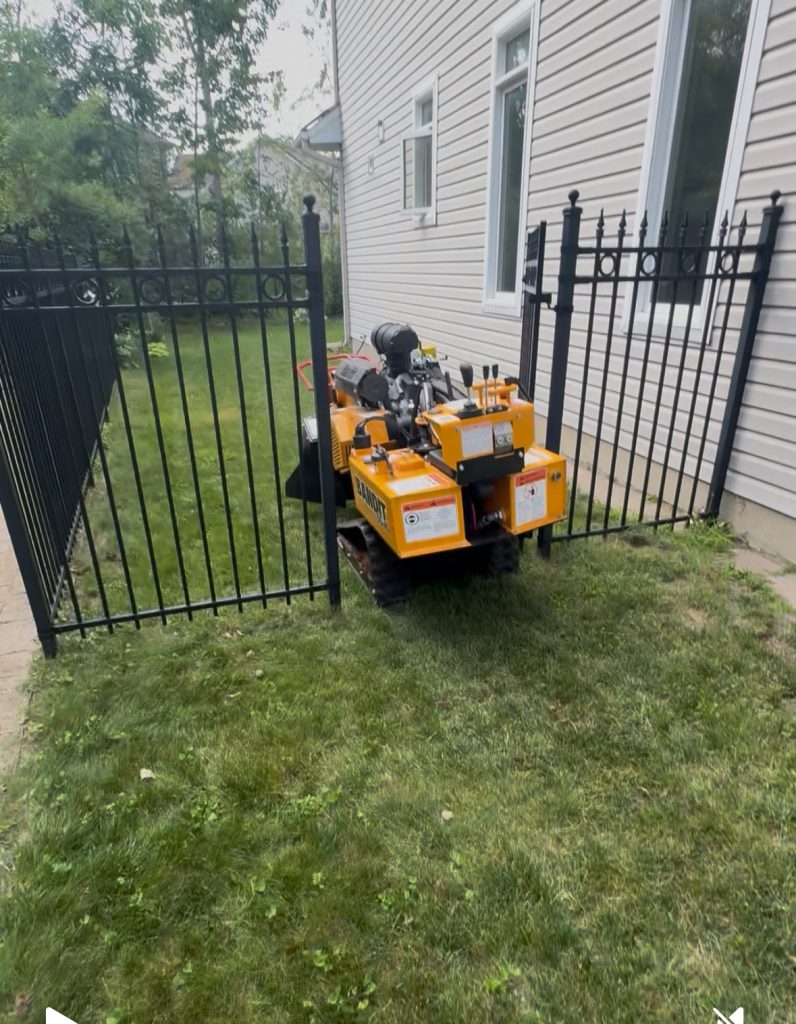
Grind the stump before you replant. Grinding takes the stump 20 to 30 cm below grade and leaves the root plate to break down; starting price is $250 for a stump 30 cm across or less, with ash carrying the roughly 20 per cent hardwood adjustment. Stump grinding detail and full price table →
Not sure what you are looking at?
Send us a photo of the trunk and one of the whole tree from a distance, and we will tell you honestly what stage it is at — including if the answer is that it is fine and you should leave it alone.
Ask about your ash → · How removal works →
Quick answers
Can an ash tree recover from emerald ash borer on its own?
No. Untreated ash in an infested area does not recover. The realistic choice is TreeAzin injections every two years for a tree still worth saving, or removal and replanting.
Is my ash worth treating?
If it still holds most of its crown and it is a tree you would not want to lose, yes — provided you accept a repeating cost every second year. Past roughly a third of crown loss, treatment is money spent slowing a decline that has already gone too far.
How long can a dead ash stand safely?
Not as long as people assume. After about two or three winters standing dead the wood is brittle enough that it cannot be trusted to hold a climber or a rigging load, which forces a bucket or crane. Remove it while it can still be climbed.
Can I burn ash firewood from my own tree?
On your own property, yes. Moving it is the problem — a federal ministerial order restricts moving ash material out of the Ottawa and Gatineau regulated area. Do not take ash firewood to the cottage.
Not sure whether your street is inside the urban boundary? See Ottawa tree permit rules by neighbourhood (Kanata, Barrhaven, Orléans, the villages, Kemptville, Arnprior and Rockland).
Max Trees publishes its prices: see the full 2026 price schedule for Ottawa tree removal, pruning and stump grinding.