
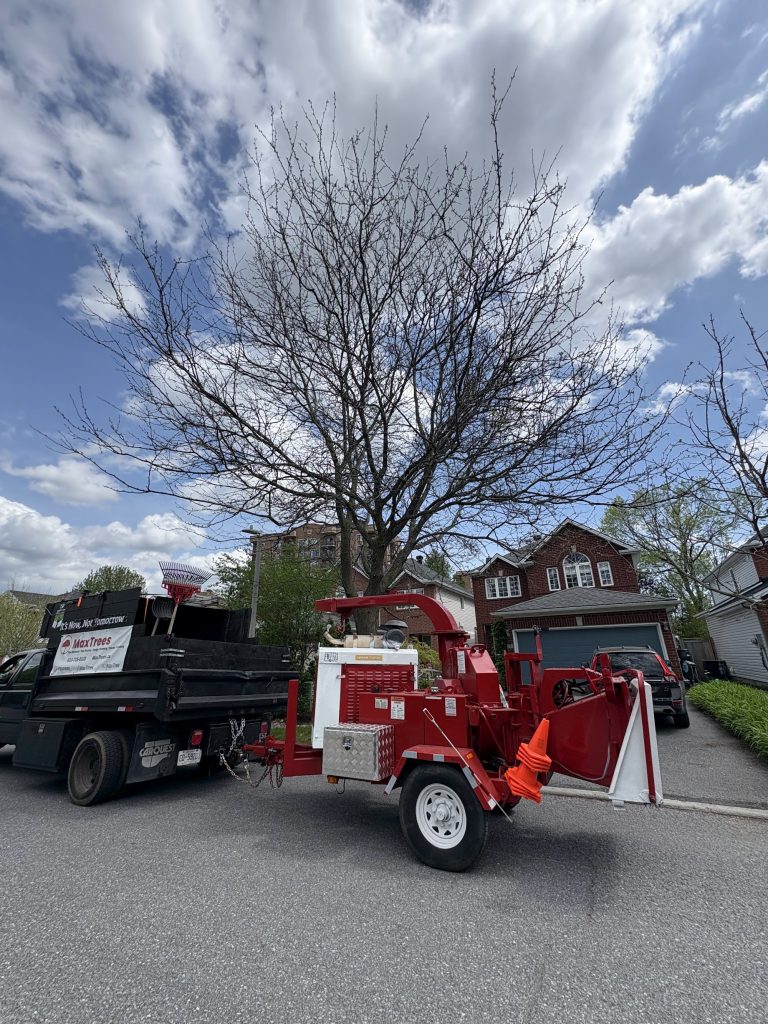
The short answer: if the tree is on private property inside Ottawa’s urban area, your lot is one hectare or less, and the trunk measures 30 cm or more in diameter at breast height, you need a permit before it comes down. If the tree is dead, or it is a genuine emergency hazard, you do not. Everything else is detail — but the detail is worth knowing, because the fines start at $500 and run to $100,000.
The rule, in plain language
Ottawa’s Tree Protection By-law 2020-340 defines a distinctive tree as any tree on private property with a diameter at breast height (DBH) of 30 cm or greater, within the urban area. Distinctive trees on properties of one hectare or less need a distinctive tree permit before removal.
Three terms do all the work in that sentence:
Diameter at breast height. Measured on the trunk at roughly 1.4 m off the ground, not at the base where the flare makes it look bigger. Thirty centimetres of diameter is about 94 cm of circumference — so if a tape around the trunk at chest height reads more than about 95 cm, assume you are over the line. In practice that is a tree roughly the thickness of a dinner plate, which most people underestimate badly. A mature front-yard maple in Beaverbrook or Bells Corners clears it comfortably.
Urban area. Lands designated in Schedule B of the Official Plan, plus the hatched areas in Schedule A. In everyday terms: Kanata, Nepean, Barrhaven, Orléans, Gloucester, Stittsville and the inner city are inside it. Properties on the rural fringe may not be. If you are near a boundary, check the specific address rather than assuming.
One hectare. Roughly 2.5 acres. Larger properties are not exempt in general — they are caught under different provisions when a Planning Act application (site plan, subdivision, condominium) is involved.
When you do not need a permit
The by-law lists exemptions, and two of them cover most of the calls we get:
- Dead trees. A tree that is genuinely dead is exempt. This matters enormously in Ottawa right now, because emerald ash borer has left thousands of standing dead ash across the city.
- Emergency hazard removals. A tree that presents an immediate danger can be dealt with without waiting for a permit.
- Work by the City or its local boards, licensed surveyors conducting surveys, utility companies maintaining their transmission and distribution systems, licensed pit and quarry operations, and normal farm practices.
A word of caution on the first two: “dead” and “hazardous” are not whatever you decide they are. A declining tree with leaves on half its crown is not a dead tree. If you are relying on an exemption, be able to show why it applied — photographs before the work, and an assessment from someone qualified to make the call, are worth having.
Municipal trees are a separate and stricter matter
A municipal tree is any tree located completely or partially on City-owned property — including boundary trees straddling the line. Removing or pruning one requires a municipal tree permit. On a lot of Ottawa streets the tree between the sidewalk and the curb is a City tree even though you mow around it, and on ravine lots in Gloucester or along Green’s Creek the boundary is genuinely ambiguous.
This is the single most expensive mistake a homeowner makes. If there is any doubt about whose tree it is, establish that before anyone starts cutting.
What the process looks like
A tree permit application requires tree information — species, size, condition, and the justification for removal — prepared by someone qualified to assess trees. For larger or more complex situations the City asks for a fuller tree conservation report. There is an application fee per tree; the current amount is published on ottawa.ca and is worth checking before you budget, because it changes.
Expect the process to take weeks rather than days, and expect the City to ask about compensation — replanting on your property, or a payment in lieu — for a distinctive tree removed for reasons other than its condition. Build that into your timeline. A removal you want done in October should be applied for in August.
What it costs to get this wrong
Penalties under the by-law run from a minimum of $500 to a maximum of $100,000, and special fines can exceed $100,000. Continuing to work after a stop-work order carries $500 to $10,000 per day, with no daily cap.
Those are not theoretical numbers designed to look scary in a by-law. Tree removal is loud, visible, and takes hours — neighbours notice, and the City follows up on complaints.
Outside Ottawa, none of this applies
This is where a lot of bad advice circulates in the Valley. The City of Ottawa’s by-law covers the City of Ottawa. It does not apply in:
- Kemptville — Municipality of North Grenville
- Arnprior — Renfrew County
- Rockland — City of Clarence-Rockland, Prescott and Russell
Each of those municipalities has its own rules covering woodlands and municipal trees, and they are not the same as Ottawa’s. If a contractor tells you that you need an Ottawa distinctive tree permit for a tree in Kemptville, they have not checked. Ask the municipality directly.
The practical sequence
- Measure the trunk at chest height with a tape. Over about 95 cm around means you are likely over the 30 cm diameter threshold.
- Establish whose tree it is. Any part of the trunk on City land makes it a municipal tree.
- Establish whether it is dead. If it genuinely is, the exemption likely applies — document the condition anyway.
- Check your address against the urban boundary if you are anywhere near the rural fringe.
- Apply early if a permit is needed, and expect a compensation or replanting condition.
How we handle it
We measure the trunk at the quote and tell you plainly which side of the threshold your tree sits on, before the job is booked. If a permit is needed, we say so — even though it means the job is delayed by weeks and we are the ones waiting. A company that skips that conversation is not saving you time; it is moving the risk onto you.
See how tree removal works and what it costs → or ask us about your specific tree →
This guide summarises the by-law as we understand it and is not legal advice. By-laws change. Confirm the current requirements with the City of Ottawa before you rely on anything here.
Quick answers
Do I need a permit to cut down a tree in my own backyard in Ottawa?
Yes, if it is 30 cm or more in diameter at breast height, you are inside the urban area, and your lot is one hectare or less. Ownership does not exempt you — the by-law regulates distinctive trees on private property specifically. Dead trees and genuine emergency hazards are exempt.
How do I measure diameter at breast height?
Put a tape around the trunk at about 1.4 m off the ground and read the circumference. Divide by 3.14 to get the diameter. Anything over roughly 95 cm around is over the 30 cm diameter threshold. Measure on the trunk, not at the flared base.
What if the tree is dying but not dead yet?
That is the grey zone, and it is worth resolving before work starts rather than after. A tree with leaves on part of its crown is not a dead tree for exemption purposes. Get the condition assessed and documented; if a permit is needed, apply.
Can I be fined if a contractor removes the tree without a permit?
The property owner is the one the by-law looks to. Penalties run from $500 to $100,000, and a stop-work order carries $500 to $10,000 per day with no cap. A contractor who does not raise the permit question is transferring that risk to you.
Not sure whether your street is inside the urban boundary? See Ottawa tree permit rules by neighbourhood (Kanata, Barrhaven, Orléans, the villages, Kemptville, Arnprior and Rockland).
Max Trees publishes its prices: see the full 2026 price schedule for Ottawa tree removal, pruning and stump grinding.