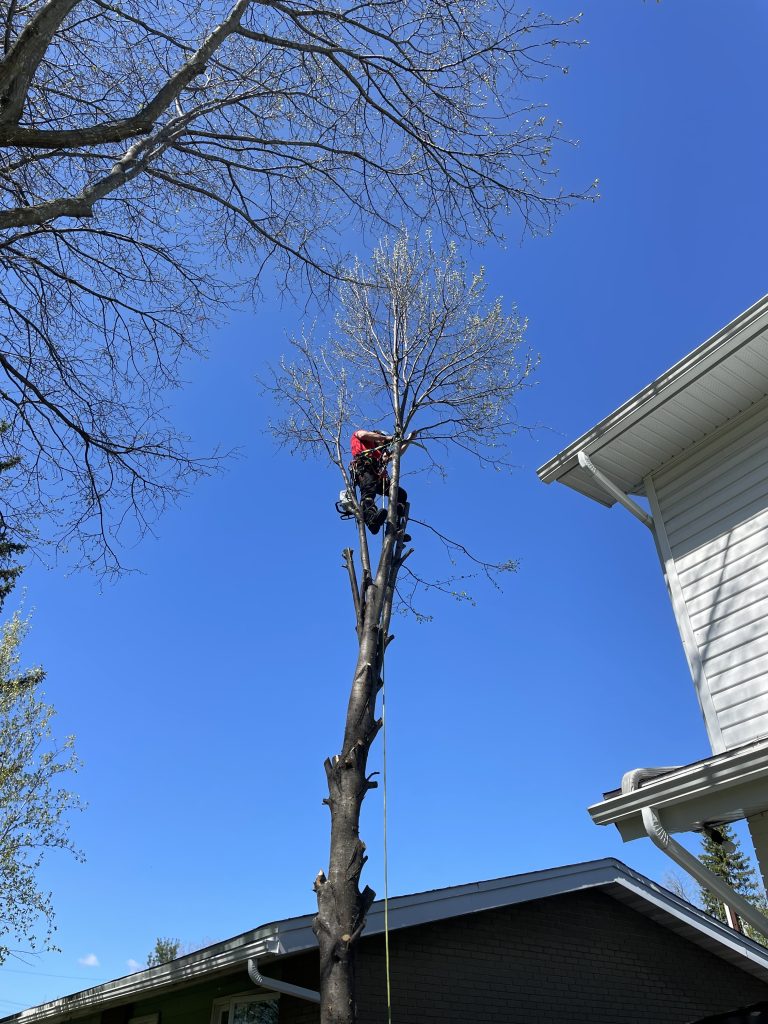
Taking a tree down in winter will not make the quote much smaller, but it is easier on your lawn, easier to read with the leaves off, and it keeps the job clear of nesting season. For most planned removals in Ottawa, December to March is the better window. For a tree that is cracked, leaning or hanging over the house, it is not a window at all. That one comes out when you find it.
So the useful question is not “is winter cheaper.” It is “should I wait for winter for this tree, or is waiting the mistake.” Here is how we answer that on a driveway.
Winter does not change how the price is built
A removal quote is built from the same things in January as in July: how big the trunk is, what is underneath it, whether the truck can get to it, and how sound the wood is. We set those out in our guide on what a tree removal costs in Ottawa. Season is on the short list of things that move the number less than people expect.
Where winter helps is around the edges. A bare tree is quicker to read and plan. Frozen ground can let equipment get closer to the tree instead of carrying every piece across a soft lawn, and less carrying is less time. But nobody should promise you a winter discount for a tree that has to be climbed and lowered in pieces over a roof. That work takes what it takes.
Quotes are free all year, and the price you agree to before work starts is the price you pay.
What frozen ground actually buys you
The real benefit of a winter removal lands on your yard, not your invoice.
- No ruts. In a wet October, a loaded truck or a stack of rounds on the lawn leaves marks you will be looking at until June. On ground that is frozen hard, the same work leaves far less behind. We say the same thing in our guide on when to prune trees in Ottawa: frozen ground takes equipment and foot traffic without rutting a lawn.
- The garden is asleep. Perennial beds, shrubs and the lawn are dormant. Brush dragged across them in January does a fraction of the damage it does in July.
- You can see the whole tree. With the leaves off, every union, crack, dead limb and lean is visible. That makes the rigging plan easier to get right the first time.
- Less to haul. No leaves means less material through the chipper and less cleanup in the beds.
The catch is the word frozen. A January thaw turns the same lawn back into mud for a few days. If the ground goes soft on the day, a careful crew changes the plan: mats, a different route in, or a different day.
The birds are the part most people do not know about
This is the reason we like planned removals done outside the summer, and it is a legal point, not a nice-to-have.
Under the federal Migratory Birds Regulations, 2022, Environment and Climate Change Canada states that “the nests of all species of migratory birds are protected when they are occupied, that is they contain a live migratory bird or viable egg (so generally during the breeding season).” Clearing trees is on its own list of activities that can harm nests, and its advice is plain: “The best way to avoid disturbing or destroying active nests is to avoid conducting harmful activities during the breeding season.”
ECCC’s regional nesting table puts the general nesting period for southern Ontario and southern Quebec at early or mid April to late August, depending on the zone. It also warns that local dates can start earlier or run longer. A removal booked for February sidesteps the question. A removal booked for June means someone has to look for nests first, and an active one can stop the job.
There is one exception that matters in winter too. ECCC lists 18 species whose nests are protected year round, even when empty, unless the regulations’ conditions are met. The one on that list a homeowner here is most likely to run into is the pileated woodpecker, which nests in large cavities it digs into trees. Its waiting period is 36 months. If a dead tree on your property has a large woodpecker cavity in it, say so when you call. That one gets checked before anyone cuts.
Elm and oak have their own reasons to wait
Two species in this city come with dates attached. The Canadian Food Inspection Agency says elm “should not be pruned anywhere in Canada from April 1 to September 30,” because fresh wounds attract the elm bark beetles that carry Dutch elm disease. The same page says the movement of infected elm material can spread the disease. A dead or dying elm is better taken down in the cold months, with the wood dealt with properly rather than stacked as firewood.
Oak runs on a similar logic for oak wilt, and we cover the window in the same pruning guide. If you have elm or oak work to plan, winter is the default.
What winter makes harder
Winter is not free. Some of it is our problem and some of it is yours.
- Short days. In December there is far less light to work in. A big removal may run over two days that would have been one in June.
- Frozen wood is less forgiving. Wood in deep cold behaves differently in a felling cut. The cuts are planned with that in mind, which is one more reason a winter removal is not automatically quicker.
- Ice on the tree. A tree carrying ice is heavier and slicker, and we will not climb it that day.
- Snow hides things. Stumps, edging, a buried garden hose, the edge of the septic bed. Tell us what is under the snow before we drive on it.
- Access. A snowbank at the end of the driveway can decide where the truck parks. Clearing a path to the tree before the crew arrives saves real time.
The trees that should not wait for winter
Everything above is about planned removals. A tree with a fresh crack at the base, a lean that is getting worse, a big limb hanging in the crown, or a split union over the house is a different conversation.
Waiting for frozen ground on a tree like that is a bet that nothing arrives first. In Ottawa, what arrives first is usually wet snow or freezing rain, and those loads land on exactly the weak joints. We wrote about that in our guide on wet snow tree damage in Ottawa. If a tree has a hazard you can see from the ground, that is a call now, not in February.
What we would not do
- Tell you to wait for winter on a tree that is already failing. The lawn grows back. The roof does not.
- Take down a healthy tree because it is winter and the crew is free. Season is a reason to time a removal, never a reason to do one.
- Run a loaded truck across a lawn in a thaw because the job was booked for frozen ground. We change the route or the date.
- Climb an iced-up tree to keep a schedule.
- Cut a tree with a woodpecker cavity in it without checking what nests there first.
- Skip the paperwork because it is winter. The City’s tree rules do not take the season off. If a permit applies to your tree in July, it applies in January. Our Ottawa tree removal permit guide covers when one is needed.
If you want eyes on it
Quotes are free and photos are welcome: the whole tree from far enough back to see the top, the base, and anything it hangs over. A quote in November means the work can go in the first good frozen stretch, and the stump can be planned at the same time. If the tree is cracked, leaning or hanging over something, do not wait for the ground to freeze: call (613) 715-0103. We are fully insured, with a commercial general liability certificate available on request.
Request a quote · Tree removal
Quick answers
Is tree removal cheaper in winter in Ottawa?
Not by much. A removal is priced on trunk size, what is underneath the tree, access and the condition of the wood, and the season moves the number far less than any of those. Winter can shave some time when frozen ground lets equipment get closer, but the bigger benefit is less damage to your lawn and garden.
Can a tree be removed when the ground is frozen and there is snow?
Yes, and frozen ground is often the best time for a planned removal because equipment does far less damage to a lawn. Snow mainly changes access and what you need to tell the crew about, such as gardens, septic beds or buried services. Ice on the tree itself is different: we do not climb an iced-up tree.
Can I cut down a tree with a bird nest in it?
Not while the nest is occupied. Under the federal Migratory Birds Regulations, 2022, nests of migratory birds are protected when they contain a live bird or a viable egg, which generally means the breeding season. Nests of 18 listed species, including the pileated woodpecker, are protected year round, so a tree with a large woodpecker cavity gets checked first.
Do I still need a City permit to remove a tree in winter?
The season does not change whether a permit applies. If your tree needs one in July, it needs one in January. Our Ottawa tree removal permit guide explains when one is required.
Photo: a Max Trees climber working up a bare tree beside a house, from our own job photos. Sources: Environment and Climate Change Canada, guidance on reducing risk to migratory birds (page dated 2023-07-26) and general nesting periods (page dated 2025-01-20); Canadian Food Inspection Agency, “Dutch elm disease” (modified 2026-06-16). All read 2026-10-30.
Every job is quoted for free, in writing, before work starts: see how we price tree work in Ottawa.
Related: if the tree is cracked, leaning or hanging now · how to tell a settled lean from a failing one · dead ash trees · the Ottawa permit rule in your neighbourhood · the Ottawa tree care calendar, month by month · planning the stump at the same time · tree-work terms, defined · our published prices.